Showing posts with label teh casualz. Show all posts

Wednesday, May 14, 2014

Please Stop Complaining About Free Mobile Games Now. PLEASE.

God. When did Indie game developers start acting so darn superior all the time?
Like many self-declared oh-so-serious gamers, I've long been irritated by casual mobile free to play games. I finally managed to get over that. I don't know what was wrong with me. Things now are just fine.

Ok, yeah, we know, we've all heard the arguments. Mobile games are too dumb. Too brightly colored. Too greedy. It's irritating to see ads, to be asked for money. They make too much of their money from compulsive "whales." We're nerds, and grannies are sneaking into our seekrit kewl gamer basement. Mobile game developers are too obsessed about money metrics and not enough about creativity. (As if the Indies are blameless on that score. "But my new tower defense game is really groundbreaking!" Please stop talking to me now.)

Mobile games are not what gamers and Indie developers want gaming to be. And this is the Internet, so, if anyone likes something different, THEY MUST BE DESTROYED.

Yes, you've had your say. You don't like mobile games. We got it.

So please give it a rest already?

So Jeff, What Got Up Your Butt?

Lots of things, but this tweet was kind of the final straw. In my butt. #mixedmetaphorpromode

Sure. I'll get right on saving mobile gaming, as soon I finish this Hearthstone match. Then I'll ... WHAT? RELEASE THE HOUNDS AGAIN? I HATE HUNTERS SO MUCH!!!
I feel a little bad picking on Notch here, because he's a decent guy and critiquing tweets is already a waste of time, but his tweet bugged me for two reasons.

First, "save mobile gaming?" From what? Being crushed under a giant avalanche of cash?

Second, this is a smug dismissal of a huge chunk of the game industry that keeps a lot of developers employed making games that a lot of people really like. It's also the most emotionally manipulative argument possible: OH, won't someone think of the CHILDREN!?!? ("Honey, are you letting little Billy playing Clash of Clans?" "Yes." "You MONSTER!")

By the way, in my observation, the younger generation isn't playing mobile F2P. The kids are spending all their time in Minecraft. Somehow, I think they'll be fine.

(Actually, if you want a better example of the Indie Developer sense of superiority, this recent article in Polygon is the gold standard. His attempts to use mathlogic to prove that these immensely popular games are actually hated are genuinely amusing.)

While we're all relieved that Indie gaming is ready to swoop in and save us from what we want, those of us who hate mobile games should take a moment to consider why we do. Speaking to gamers here: When you viscerally hate something that has never hurt you personally (or even affected you, really), it is possible that the true problem is really somewhere inside your own head.

So let's examine some of the reasons why we fear and hate our new Mobile F2P masters.

"Hearthstone doesn't count. I don't consider one of the bad free games." Yeah. Everyone says that about the one they like. 

One. "The People Who Make Them Are Soulless Business Drones. Not Cool Arteests Like Us."

Yeah, pretty much. I've been to casual/mobile game trade shows, and, man, that is so not a nerdy place. It's a bunch of NormalPeople and MBAs, with nice clothes and haircuts, tossing around weird business terms like ARPU and ARPDAU and AMPU and DILDONG. And sure, they all like Game of Thrones, but they don't like it in the correct way we do.

Sometimes I think that the gamer hate for mobile is not because it's unsuccessful (because it's massively profitable) or because they provide people with mind-boggling amounts of leisure fun (because they do), but because they remind us of the grade school bullies who laughed at us and took our lunch money. But this time they're doing it inside OUR industry.

People who write free games, from Candy Punch Saga to Hearthstone are doing what we do, but better. (And yes, Hearthstone has "Casual" appeal too, whatever that means. Ten million registered accounts says so.)

The people making those games may not being doing it our way, by our metrics, but they are passionate about giving lots of people something they like. Hell, they care about how many people play their games way more than I do. They'll lose a week's sleep over increasing their player base by 0.01%, because that might be the edge they need to stay employed.

The sheer scale of the entertainment they provide is mind-boggling, and they're doing it mostly for free, with, by the way, game systems that mere mortals can actually understand.

Why did free games take over the world? Well, you can pick up the entirely of Hearthstone in five minutes. Think you understand the rules to Magic: The Gathering? Nobody does. Look what it takes to understand that game.  It's madness.

Maybe accessibility is our problem. "Hey, man, I was wasting my life stressing about impenetrable rules systems before it was cool."

Two. "They Write Simple Cartoony Games For the Most Casual."

And they're rich. Aren't you just angry you didn't think of it first?

What people seem to ignore is that these games provide the most challenging hardcore experience available in games today. Want a rough time? It's simple: Don't spend money.

(A common logical error made when analyzing mobile games is seeing that only a small percentage of people spend cash and concluding this means people don’t like the games. This is a huge mistake. I’ve never paid a penny on free games, including several I love. This just means that I’m awesome.)

Free games, even the more casual ones, solve the great problem in game design. They thread the needle between Casual and Hardcore. Want a light, easy experience? Spend a little money. Want a punishing experience that takes lots of time and care? Play for free.

Yes, if you pay for free, they'll put a lot of time blocks in your way, both arbitrary waits and levels you'll lose a lot of time. But that's what serious gamers want, right? To do something hard and finally succeed? And this time it's even more fun, because you did it for FREE. It feels like you got away with something!

Hay Day, and enormously popular F2P game. I only put up this image because I think it'll annoy gamers.
An Aside. You Think You Know Hardcore? You Don't Know Hardcore!

People who ask for and play tough games are really full of themselves. We all know that. You won Dark Souls? That's nothing. I have a friend who beat Candy Crush Saga without spending a penny. Took months. You want strategy and grueling persistence? There it is.

And she's not a gamer by any stretch of the imagination. She's as casual and casual gets, and she's a more dedicated, obstacle-toppling gamer than you are. Even if her game involves hitting a spastic teddy bear with clumps of purple gumdrops, or whatever.

Three. "If You Don't Pay, You Have To Spend a Lot of Time Getting Power."

Sure. And this makes it different from non-free games how, exactly?

People have a problem with this now? Well, I don't remember gamers having a problem when we all burned up our youths in the twin furnaces of Everquest or World of Warcraft. Used to be, in Everquest, every fifth level was a "hell level," where they doubled the number of experience you needed to pass it for no reason. It was arbitrary, obnoxious, and ridiculous. I still have nightmares about level 45.

If you complained about it everyone jumped down your throat and called you dirty names. Players just spent the hours grinding. With great concentration, you could convince yourself that you were having fun.

Now, the worst thing that happens is the game, to advance, forces you to pay or get this to stop playing for an hour. You don't even need to spend that hour killing the same goblin over and over again. You can go do something else!

Seriously. Whatever ridiculous hoops free games make you jump through to advance? Hardcore gamers have gone through ten times worse. And we did it to ourselves. And we convinced ourselves it made us cool.

An Aside. Of Course, It Can Be Done Badly. Of Course.

It's not hard to make a F2P game that sucks. A recent instructive example of the Internet Anger/Entitlement Complex was EA's free Dungeon Keeper game.

Now, I never played it. And neither did 19 out of 20 of the people who complained about it. From what I heard, it committed the cardinal sin of making people wait too long to do anything and forcing them to spend money to see any of the game's cool stuff.

And they were punished for it. Even in the ancient shareware days, we knew that the free version had to be enough to addict your customers. Dungeon Keeper didn't do this, and it messed up in the harshest, most unforgiving of markets. Result? Don't bother to look for it in the top sales charts. It's not there.

But that has nothing to do with the bizarre level of screeching that accompanied its release. To hear gamers talk, it's like EA defiled some sacred institution of modern society.

Dudes, I was there when Dungeon Keeper came out. I bought it with real money. And ... It was fine. Halfway decent. And that's it. Look at it this way. If it was such a hot property, why was the license allowed to lie fallow for fifteen years?

(Bonus Young Developer Advice: Looking for a game idea? The apparent desire for a new version of Dungeon Keeper might be something you can profitably take advantage of.)

"I have two jobs, three kids, and four minutes to rest." Why don't you spend that time pretending to have a miserable, meaningless life? "Because I don't hate myself."
Four. "These Games Are Shallow and Don't Provide a Rich Artistic Experience."

Yes. Thank God.

I've lost count of the number of indie developers who cursed these games as being mere time-wasters and dopamine-generation buttons. Why wouldn't you instead play an iphone game that provides a varied, rich artistic experience, like ... like ... Yeah, I don't know either.

Look, don't listen to indie developers. We all may be, oh, I don't know, a tiny bit in love with ourselves? I missed it when the world elected us the High Princes And Arbiters Of Leisure Time.

Candy Crush Saga fans aren't sheep or Muggles. They are making highly rational choices about spending limited time and/or money for maximal rest. Papers, Please! is a great game, but it's also stressful and depressing. If you look down on someone who prefers Pet Rescue Saga, you may have lost the plot on this whole "game" thing.

Some may have forgotten that, most of the time, all people want is a painless way to escape stressful reality for five minutes while waiting for the bus.

Five. "Casual Games Monetization Isn't Ethical."

The best evidence is that a tiny fraction of mobile games players make up a huge chunk of the income. These super-players are called "whales." It's really interesting.

I used to be concerned about it. Not so much, now.

I was uncomfortable with a business model of coldly extracting most of your earnings from a tiny percentage of "whales" in your user base, but it could be WAY worse. There's a hundred casinos within an hour's drive of my house, and those icehearted bastards will take your house, smile, and sleep like a baby afterwards. Who is protesting them? At least nobody ever lost their kids' college money playing Candy Crush.

I hate to get all Robert Heinlein on you, but unless Zygna agents are sneaking into your house in the middle of the night to load Epic Bakery Candy Saga Pony Plus on your phone, the reason people play these games is because they like them. They picked them out of a market that provides a million places to hop to if their current game irritates them. I'm sorry if it angers you if someone chooses to play Flappy Bird or 2048 instead of your soul-enriching art piece, but that's the breaks.

(Of course, when these games have actual gambling, it'll be a moral apocalypse. Argument for another day.)

Fun Still Matters. Games, Remember?

My wife has a serious love/hate relationship with these games. When Candy Blast Mania hits her up for cash, her eyes glow incandescent with rage. And yet, she's burned through hundreds of levels, exterminating bosses with robotic efficiency. Not paying for it only makes it more fun.

I won't embarrass us by revealing how thoroughly Hearthstone has occupied our brains. Again, not costing a penny.

I'm always in awe of people's ability to take a cornucopia of wonder and upend it, pawing through the treasures within in the hope of finding a dried rat turd or something. We're getting an awesome deal here, people. Perhaps too awesome. There's probably a big business shakeout approaching this market in the next few years, but it's nothing compared to the apocalypse small Indie developers are about to face.

(Don't believe me? Go here and watch the first minute. This is the way the world ends.)

Daily earnings for the top ten mobile games. I think my favorite thing is that some people think the war isn't over.
The Peace of Letting Go

So you might as well be cool with it. Because, well, look at this sales chart. Those revenue figures are per DAY.

This isn’t competition. This is implacable domination. This is the Huns stampeding over the border, driving the survivors into the caves, and salting the earth. Except that the Huns, in this case, were us.

The people have spoken, the bastards. For Indie developers to say to gamers, “No, you poor, lost little lambs, this isn’t really what you want. Let us saaaave you,” is getting more than a little embarrassing.

Indie was, is, and always will be, niche. Add up all the earnings of every Indie game last year, Minecraft included, and it’s probably still less than Supercell’s monthly Snapple budget. All we can do, going forward, is find a way to deal with it.

In our house, dealing with it will include a lot of Hearthstone. And, of course, gathering colored candy into easily extracted clumps.

Monday, January 13, 2014

Yes, It's a Game. They're ALL Games. STOP ARGUING.

Yes, in fact, I do have Know Your Meme bookmarked. Why do you ask?
I've been taking a long break playing through the dozens of unplayed indie games in my Steam queue. My biggest surprise was that all of my favorite experiences were what I privately call Storytelling games: Games with minimal gameplay, that mainly exist to tell a story.

You've been hearing about them for months. Gone Home. Stanley Parable. Papers, Please. (In my opinion.) To the Moon. Amnesia: Machine For Pigs. Storytelling Games really broke big in the last year.

But it's still the Internet. There is no conversation so interesting and new that someone won't break in and try to derail it into a pointless argument. So ...

Stop arguing about whether a game is a game or not. It's a useless distraction. STOP IT.

Why?

When someone says, "That isn't even a game," they are actually saying something else.

One. It's Impossible to Define What a Game Is.

No, seriously. Try it. Whatever definition you come up with, half of everyone else will disagree. The other half will instantly poke a ton of holes into it.

We're talking art here. Getting a firm definition of anything is impossible.

Consider Big Fish Games, a hugely successful publisher of casual games. Think of it as Steam for your grandmother.

Have you looked at casual games lately? One of the biggest categories on Big Fish Games is Hidden Object Games, which is exactly what it sounds like. "There is a squid somewhere on your screen. Click on it."

This is an activity that doesn't involve pwning a dozen robotorcs while cycling through a dozen hotkeyed abilities at top speed, so plenty of hardcore gamers wouldn't consider it worthy of the lofty title of "Game." But Big Fish Games does sell games. You can tell because they have "Games" right there in their name.

(Of course, whenever anyone says, "That isn't a game," it's just thinly disguised bragging about how awesomely hardcore they are. Whatever the filthy casuals are doing over there, it doesn't deserve to be lumped in with the cool kid stuff we do.)

Personally, I think a Hidden Object Game barely even counts as an "activity." But it's still a game, and if a Hidden Object Game is a game, everything is.

A screen from the delightfully aggressively named Witches' Legacy: Hunter and the Hunted. Now click the squid. Click, it, DAMN YOU! CLICK IT!

Two. Dividing Games Into Games and Not-Games is Useless.

I mean, why would you even want to come up with categories like Game and Visual Novel and whatever? It wouldn't do any good, as everyone has a different idea of what a game is.

You know something? I've decided that I don't think simulators should be considered games. Gone Home is like a Hidden Object Game, so it's a game, but Call of Duty is a war simulator, so it's not a game. So there! (Drops mic.)

What did you think of that last paragraph? Do you think I sounded like a crazy person? Well, that's how YOU sound if/when you say Gone Home isn't a game.

Coming up with different ghettos to stick games into doesn't do any good, and it keeps us from doing what's really interesting: Talking about the works themselves.

Three. You Really, Honestly Can't Come Up With Something Better To Talk About, Seriously?!?!?!?

This is a time of wonders for gamers. 2013 saw the release of a huge number of fantastic, innovative, and ground-breaking titles, on the indie and AAA level. It was a year of delights. Even games I had a lot of problems with were still super-fun.

We should be spending out precious and limited time talking about the games themselves. What they did right. What they could have done better. What is still technically or budgetarily impossible for them to do. (The last one is a really important, under-discussed topic.)

That someone could be greeted with all of these delights and all they can do is pick a semantic argument? The art form is growing fast now, guys. It's way, WAY too early to start pigeonholing things yet.

---

As always, we're still on Facebook and Twitter.

Monday, October 28, 2013

The Fun of Being Bad. The Fun of Fun.

SOLD!
I've been writing a lot lately about video games that are really well designed and written. Games like Spec Ops: The Line and The Last of Us. First-rate, intelligent titles that are only held back by the fact that, let's face it, they are gigantic bummers.

Let us never forget that video games are games. They are supposed to be fun. They are capable of, in rare, magical moments, providing genuine joy.

I wanted my last article in this little series to be about Saints Row IV, the most efficient joy-production machine I have experienced in many a year.

But I need to make the topic a little broader than that. I want to talk about the most delightful, unique, transgressive pleasure that our young art form can provide: The fun of being bad.

This was controversial once. Simpler time.
The Justifiable Fun of Being Bad

In 1976, a company called Exidy released a video game called Death Race. In it, you control a car and run over little people. You try to crush as many as you can inside of a time limit. When you hit them, they made an adorable little squeak. I played the heck out of it. Yes, I am comically old.

See, the genre of Having Fun Doing Horrible Things is almost as old as video games themselves. There have always been and always will be games that let you have fun being bad. Robbing shops. Running over pedestrians. Generally being a reprobate.

There is absolutely nothing wrong with this. Video games are imaginary. They are places where we enact our fantasies. Sometimes, our fantasies are bad. That is why they are just fantasies.

In real life, I am snappish but basically mild and entirely non-violent person. I have played four Grand Theft Auto games front to back, and I always ended each session with a crazed kill-rampage. No apology is forthcoming.

This Is a Hard Trick To Pull Off

Making a game that makes doing evil things funny and fun is really difficult. Players don't seem to realize how tricky this is. Most people are feeling, empathic creatures. If you get the tone just a little bit off, if you make the suffering just a tiny bit real, if you let the player think for one moment about what the thing they are doing on the screen actually means, the spell is broken.

This is why, no matter how big the world of Grand Theft Auto V or Saints Row IV is, no matter how much you wander, you will never see a child running free. This is why these games, for all of the horrible crimes you can commit, will never depict a rape.

It's a delicate bit of alchemy. One of my favorite Grand Theft Auto missions ever involves repeatedly shooting a guy in a full body cast with a rocket launcher. It was just the right level of ludicrous to be hilarious.

If you can't possibly see how this could be funny, please, I beg you, never watch a Road Runner cartoon. The things that poor coyote goes through will break your heart. All he ever wanted to do was eat.

And then I turned off the Playstation and didn't turn it on again for a week.
So Don't Miss the Point

I have been a huge Grand Theft Auto fan for a long time, so the way the designers have completely lost the thread of what they're trying to do pains me greatly. The most discussed scene in the game involves the long, slow, graphic torture of a prisoner with jumper cables, pliers, a wrench, and gasoline. Here's a video of it! Enjoy! (Skip to 6:50 to really get the good stuff.)

Did you watch it? Of course you didn't. Why on earth would you?

And yet, why wouldn't you? Didn't you hear? Grand Theft Auto V has a 97 on Metacritic. That is basically perfection. It made a billion dollars in like a day. It is, critically and financially, the absolute pinnacle of the art form. Don't you like video games? Why would you not want to see the pinnacle of the art form?

But Anyway

Of course, this scene (and so much of the rest of the game) has been criticized for just general horribleness, to which people who don't get it respond, "But Grand Theft Auto is about having fun being bad."

This misses the point. If you want people to get that jolt of transgressive joy, you have to be more careful about what you make them do, not less. I don't know who, beyond adolescent boys, could ever have actual fun playing that scene. Game-design-wise, it's simply an unforced error.

Video games are maturing as an art form. The stuff you can't get away with in movies and TV? Soon, they won't be permissible in video games either. Civilization inflicts its requirements.

On the other hand...

Yeah, things get a little weird.
It's All In the Little Things
"Like all good stories, the second act begins with a call to action and the building of a robot." - Narrator, Saints Row IV.
Saints Row IV is a rare pleasure. It's a game that knows exactly what it is. It's not about internal consistency or artistic statements. It's about packing as much simple, senseless joy, lowbrow and high, into a game as they it possibly can.

(Disclaimer: It is the only Saints Row game I have ever played.)

It is a game that features:

The protagonist riding a nuclear missile, Dr. Strangelove style, ripping out components to disable it while your friends eulogize you on the radio and the theme song from Armageddon plays. It's pure, ridiculous genius.

A gun that shoots black holes. I can image how balancing Saints Row IV went. The designers sat down at a table, gave it some quiet reflection, and went, "Wait a second. Never mind. Our game has a BLACK HOLE GUN."

Also, the dubstep gun.

In a scene almost impossibly sweet for a game like this, you and one of your friends drive to a mission together while singing Opposites Attract. I've played a lot of games like this, but this is the only time I ever drove more slowly to hear all of the dialogue.

Zipping through the Matrix on Tron light cycles while the evil alien overlord Zinyak recites the Tomorrow and Tomorrow monologue from Macbeth. ("I don't listen to Scottish hip-hop.")

And if none of this makes Saints Row IV sound like a game you'd want to play, that's cool. Tastes legitimately differ. But can't you see how it's the sort of game a LOT of people would want to play? (Excellent pacing, satisfying super-powers, crisp writing, and an overwhelming sense of just-plain-fun help a lot.)

It's a big art form. There's room for drama and humor, tragedy and mystery. But if you want to go silly, and if you want to make a game in which players can pretend to be horrible crazy criminals and still be able to look at themselves in the mirror, this is how it is done.

And, as a special bonus for old people like me who have developed actual human empathy, almost all of the game takes place in the Matrix, so I don't have to feel guilty about running people over in the street.

But You're Not Really Doing It, So Why Does It Matter?

Another point I see made a lot, which I find overly simple and not really thought out.

Yes, on one level, your conscious brain knows it's just an illusion. You "know" it's fake. In one part of your brain. Only one.

You're still controlling it. You're still seeing it. It still makes you feel. I mean, fiction can have incredibly powerful effects on people, and we all know it's not real. Controlling it yourself only increases this effect.

This is why so many people, myself included, could not possible bring themselves to shoot the giraffes in The Last of Us, as desperately tempting as it was. This is why fiction works at all. Yes, part of our brain knows it's not real. That part is the minority.

It's Too Easy? I Don't Even Know What That Means.

The main criticism I've seen leveled against Saints Row IV is that it gets too easy. This is half right. As you develop your incredible arsenal of magic Matrix powers, you become a god pretty quick. However, I really don't like criticizing a game for this.

Difficulty is only one of many things a designer has to set, and there is no right answer. Some games, like Super Meat Boy and Demon's Souls, are selling extreme challenge. Others, like most casual games, are selling a friendlier, more casual experience. There is no right answer! I hate it when reviewers pretend there is one.

Saints Row IV is a crazy, silly game that feeds power fantasies and lets you throw enemy hordes around with awesome brain power. Making it a difficult game would just be wrong for the tone. (And, if you want it to be tough, play it on the hardest difficulty level. There. Was that so hard?)

You want to fail a lot? Fine. Go play Grand Theft Auto V and die ten times trying to land the plane. We'll see who has more fun.

Oh, and one other thing. Trust me. Gamers are far more likely to forgive a game for being too easy than too hard. Most people have only a limited appetite for being told how dumb they are.

The Pleasure of Video Games is the Pleasure of Doing

And sometimes, the things you want to do are bad. Again, nobody is going to apologize for this, nor should they need to. Yes, it feels real, but no, it's not real.

It's one of the hardest things to do right. Some people are better at it than others. Now, if you will excuse me, the new Saints Row IV DLC is out. It's called "Enter The Dominatrix". That is the sum total of all I know about it. Sold. Crass fun is still fun.

Thursday, February 16, 2012

My Life's Tour Through Dungeons & Dragons, Part 2.


(This is the second part of my tour through all the editions of Dungeons & Dragons I have played. The first part can be found here.)

After many years of playing Advanced Dungeons & Dragons, the unthinkable happened. A whole new version came out. Everything was different. Our minds were truly blow. "Remake all of D&D? Is that even possible?"

Turns out, it was.

Second Edition (1989)

Second Edition took fifteen years of hard-earned design experience with RPGs and used it to round off all of the rough edges in the system. It still basically played like First Edition, but with less insanity. A wimpy giant spider could no longer instantly kill you with poison. Undead didn't drain levels permanently. Freshly minted wizards could now cast an amazing TWO spells per day. That's twice as many as before!!!

However, the combat system was still very vague. If you had someone in your group who had never played before, you could give them a Fighter to play. All they had to do in combat was pick up their figurine, plop it down next to a monster, and roll a die to attack. If the dungeon master said they hit, they picked up a different die, rolled it, and said the amount of damage. And that was it.

It is this potential simplicity (playing other classes was more complicated) that I miss most about the old game. There was a simple way to play. There isn't one anymore. Considering D&D was mainly played by groups of friends getting together for a relaxing evening, perhaps with a drink or two, this is an enormous loss.

I'm going to make an Official Proclamation now:

If a new edition of Dungeons & Dragons doesn't have an option which enables it to be easily played by a moderately inebriated person who isn't good at math, it is a failure.

Second Edition was, while still flawed, my favorite version. Then Designers got their hands on it and started, you know, Designing. God help us.

Third Edition (2000)

Never played it. Too busy with babies.

Version 3.5 (2003)

Never played it. Also, Point Five? It's enough of a change to buy new books, but not enough to be a full upgrade? Isn't that a little fishy?

Fourth Edition (aka 4E, 2008)

And then, after an absence of over a decade, I returned to D&D, only to find that the universe has completely changed. People say that Fourth Edition is trying to copy World of Warcraft, but, to be honest, I don't see it. I really don't. Instead, it feels like the hardcore wargames I played way back when I started gaming. With all the good and bad that comes with it.

It's very detailed and tactical. Everything has been formalized. Nothing is left to chance. Every movement, every action, even the act of role-playing, has been codified and given its own rule-set. It's Dungeons and Dragons and Control Freaks.

Old gamers have a reputation for only loving the version of D&D they grew up with and hating everything else, but I went into 4E determined to enjoy it. I played in a single campaign of it for over a year and had really quite a lot of fun. Dense rules? Piles of cards and abilities to keep track of? Tons of algebra? My brain was made to handle this stuff. It was great. For a while.

But if I had to come up with one word to describe the rules of 4E, it would be "undisciplined." Sure, it's a solid system, and every little thing is covered in the rules. However, there is too much going on for people to actually keep track of what is going on. The longer you play, the more cards pile up. The more abilities accumulate. The more things you have to keep track of with every single attack and damage roll.

Every single action seems to result in an effect like, "Everyone gets +1 to hit to attack the target next round, if they attack with a missile weapon, and the target is bloodied, and it is Tuesday." It gets maddening.

The last night of the campaign I played in, we were seventh level. At that point, we had three people keeping track of the state of play. The dungeon master took care of the monster actions. I kept track of initiative and effects on players. Another player kept track of effects on monsters. And even with three adult, lifelong gamers riding herd on the game, we STILL forgot stuff. All the time. Then we quit.

And teaching regular humans to play this stuff? Forget it!

I know there are many who will virulently disagree with this analysis, for whom 4E is the One True D&D. And, before you tear me apart in the comments, I will only say this. 4E has only been out a little over three years, and they have already announced another complete redesign. Don't say it's just for money ... They could make a mint releasing expansions, dungeons, campaign settings, etc. I think that already tearing everything up and starting over is a de facto admission that the design just wasn't working.

A Brief Aside and Unwanted Design Advice

A friend of mine was applying for a marketing job as Wizards of the Coast. To help her prepare, I ran a one night 4E game for her and her friends. I DM'ed a game for six women, as my daughters watched and wished they could play. It was the dream of a lifetime, come true.

However, these women were, while bright, social, and eager, not lifelong gamer nerds. Trying to teach them D&D was a fascinating experience. Based on what we went through, here is my one piece of unasked-for advice for the team designing Fifth Edition:

Whenever you write a new rule, picture a young man trying to explain it to his willing but non-gamer girlfriend, whom he has finally convinced to try out his hobby. Hell, try to explain the rule to one of your parents. If the most likely result is a confused look and glazed-over stare, just make the damn thing simpler already.

I can't say it's possible to make D&D a more mainstream hobby again. It may not be. But, if it is possible, this is the path.

What I Want, For Anyone Who Cares

For me, D&D is a chance to sit around with friends, toss back some Maker's Mark, shoot the breeze, and occasionally bounce dice and kill some bad guys. It's a social game. The more time you spend re-explaining rules and poring through huge books to try to figure out if you can charge on a triggered action, the less time you spend just relaxing with your friends.

So, kids, if you ever wonder why old folks get all nostalgic for the old rule sets, it's because, as crude and poorly designed as they were (and don't get me started on the art), they were aiming at a specific sort of play experience (loose, fast, casual), and they delivered it.

I want to teach my kids how to play D&D. I could teach them how to play Second Edition. 4E, not a chance. That makes me genuinely sad.

In ten years, when I actually have time to play again, I'm really looking forward to seeing what Eighth Edition looks like. It'll be fascinating. And, if it doesn't work for me, I still have all my old books in the basement, waiting for the End Times.

Wednesday, August 3, 2011

Don't Ask Questions Until the Player Can Answer

When I started writing fantasy role-playing games for a living, I did a lot of dumb things. Since then, it's been a painfully slow process figuring out how to be less dumb. Every time I start a new game, there is a point where I go, "Wait. Why don't I do this thing this new way? In fact, why haven't I always done it that way?" And then I slap my forehead. Hopefully, it hurts.

One of my new, hard-earned rules of design has to do with training your characters. And, since it seems like every game and its cousin has some sort of level-gaining and stat-building these days, I think the rule is getting more relevant every day:

The number of decisions you have to make to build your character should be proportional to the amount of time you've spent playing the game. The more you play, the more you should decide.

Or, to put it another way ...

Whenever you make a decision about your character at the very beginning of the game, you are answering a question that hasn't even been asked yet.

So design wonks, get ready. Here is an example from my game Avernum, released in 1999. I will compare it to the rewritten version, Avernum: Escape From the Pit, out later this year. (And this will also double as a little taste of a preview of the new game, for those who care.)

The Bad Way I Did It Before

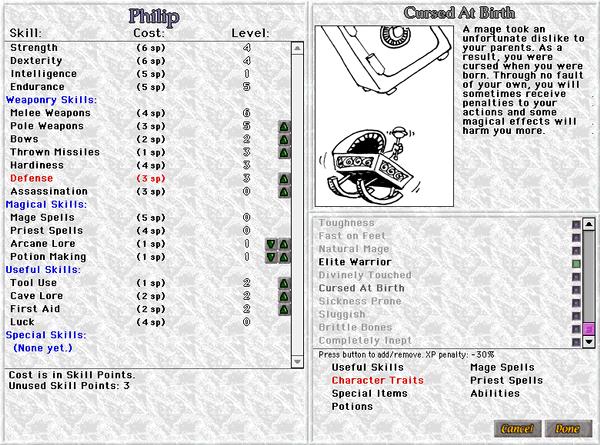
Avernum is an old school role-playing game. There are a lot of skills you can train to make your character stronger. There are the base attributes (Strength, Intelligence, Dexterity, Endurance) and regular skills (Swords, Spells, Lore, etc). You start out with a bunch of skill points, and you get more with each level. You should spend these on skills.


You start out with a ton of skill points, so that you can majorly customize your character from the beginning. You can use skill points to increase base attributes or regular skills, but the base attributes are expensive. However, it could break the system if a player put a huge amount of skill points in certain skills. To limit this, I made increasing a skill cost more skill points the higher you trained it. At high levels, you might have to save up for two or three levels to get enough skill points to raise a major skill one point.

Think about this. It's a system where the more you play and learn about the challenges facing you, the less you can do to customize your characters. You have to make most of the big changes at low level, when skills are cheap. Worse, it was necessary to increase the base attributes to survive (especially Endurance, which increases health), but they were so expensive that doing so required careful planning. As a result of this mess, many players had problems with getting halfway through the game and finding that they were not strong enough to proceed. These players got angry at me, and justifiably so.

There was also a traits system. Traits are special character qualities, some positive, some negative, that affected your characters. They could make you better at spells, more vulnerable to disease, and so on. Good traits came with a penalty to experience earned. Bad traits gave you a bonus. You could have at most two traits.

And here's the awesome part. You could only pick these traits at the beginning of the game, and you couldn't change them. Major decisions that affect how you play the entire game, and you make them before you've even fought one monster. It's very hardcore and old school. By which I mean that it's mean-spirited and unnecessarily punitive.

The Better Way I Do It Now

There are still base attributes (unchanged), skills (mostly unchanged), and traits (an all-new, very long list).

When you make your characters, you can increase five skills and pick one trait from the long list. This is far, FAR less customization at the beginning than was allowed in Avernum. Because of this, many gamers will try to make a party, think I have completely dumbed down the system, and ragequit. Price of doing business.


But then, when you gain a level, a base attribute goes up by one point. It's different each level, so every four levels each attribute has gone up by one. In addition, each level you can choose one attribute to increase by one. This allows a lot of character customization while making sure all skills go up gradually so that you won't be hamstrung by completely neglecting an attribute.

Each level, you can also increase two different skills by one point. Thus, you never stop being able to shape your characters. As you get a better idea of the challenges you are facing, you can mold your characters to enable them to proceed.

Finally, every other level, you can pick one trait from the long list. The number of available choices starts out small (to keep from confusing new players) and grows dramatically as you proceed. You will eventually have a lot of traits. Some of them give simple bonuses to your spells or attacks, while others (like Backstab or Swordmage) will affect how you actually play your character.

I plan to take a lot of heat because I allow fewer choices early on, but overall you make more decisions to mold your character in the new system than in the old system, and there are more ways to customize a character. The change means that you make a larger percentage of the decisions later on. As it should be.

Of Course, There Is No Way To Win

I have often observed that people hate change. I have tried to make a more friendly system that provides more customization, but a lot of people will be angry about the loss of the old system (which has been in place for a very long time). I can totally understand this, but I still need to always strive to make things better.

Also, while the old system made it very possible to build a party that would find itself stuck and unable to proceed. Some players actually like that. To them, the challenge of avoiding that fate is part of the game, and the threat of a failed party adds excitement to the game. For them, I can only suggest playing on Torment difficulty. It will provide ample possibility of horrible failure.

But I'm very happy with the new system. I think it allows players to answer the questions the game poses when they understand what those questions truly are. And now I enter beta testing and the actual balancing of the new system. And that, of course, is when the suffering truly begins.

Friday, May 6, 2011

On Making Lots of People Angry

The other day, after Avadon: The Black Fortress came out, a certain community of hardcore fantasy RPG fans jumped on it with universal loathing.

I thought that I had a lot of good points to be made about the perils and opportunities of listening to feedback from fans (or ex-fans), so I wrote a blog post about it. This had the entirely predictable effect of infuriating the previously mentioned community.

Now, in the light of day, I feel kind of bad about it. I think what I wrote was fairly mild and I do still stand by every word of it. However, I think I kicked a group of my fellow gamers when they were down, and, being a lifelong gamer myself, I regret that. I've been reading their posts and chatting with them and I think I understand where they're coming from a lot better now.

I am only bringing this up because this blog is mainly about indie gaming, and I think this a great opportunity to make a huge point in that area.

Here's Your Audience, Wrapped Up In a Bow

Fledgling developers write me all the time asking for advice on what sort of game to write. What I tell them is that they should look for an underserved niche and serve it. This is the Great Magic Power of Indie developers.

Here, as I see it, is the story of RPG Codex. These people love, love, love old-school hardcore RPGs. The sort that used to be common on the ground and have faded away. They were forsaken by Sir-Tech, and Origin, and SSI, and Bioware, and now me. There was a thing that they loved, and it is gone, and they are angry about it. The anger might manifest itself in unappealing ways, but it's real. Nobody likes losing what they love.

You want to do what I do? You want to make a living writing RPGs? You have skillz? Go there. Talk to them. Pick past the ranting, find the reasonable things they are after, and write that game. Do it well, and you can make money.


And One Final Word For RPG Codex

I am still a gamer at heart. The gritty, hardcore elements in Avadon are later in the game. I put them there to not scare off more casual gamers. Teh casualz need to be eased into that sort of thing.

Were you my fan, but the Avadon demo turned you off? Well, here's a challenge. We have a one year no questions asked money-back guarantee. Buy the game. Give it a few hours on Hard or Torment difficulty. (I suggest until the boss fight with Zhossa Mindtaker.)

Still disappointed? Then I don't want your money. You get it back. My lips to God's ear.

Thursday, February 10, 2011

Three Rules For Difficulty In RPGs


As I put the final touches on Avadon: The Black Fortress, I am finally wrapping up the most touchy, painful, contentious part of the game: play balance. Should it be harder or easier? Is this particular fight fair? How many players will wash out halfway through the game and be forever angry at me for my suckitude?

The fans of role-playing games are a pretty diverse bunch. Some prefer stories. Some fixate on stat-building. Some want to beat everything easily, and others are irritated if there are no challenges. It's a pretty amorphous blob of interests, and nobody can satisfy them all. I just try to appeal to as much of the blob as possible.

Over the years, I have made three observations regarding game difficulty. These are the ideas I always come back to as I decide how tough a given section or encounter will be. I think these guidelines are, to the extent anything can be in a creative endeavor, The Truth.

Observation One: There are two sorts of fights in an RPG: Fights that are supposed to be easy and fights that are supposed to provide a challenge.


In other words, first, there are fights that will almost never ever kill a player, also known as trash, or trash mobs. If your trash mobs are frequently killing the character, your balance is messed up. (Early versions of Avernum 6 had a big problem with this.) Most of the time, the vast majority of the fights in a game will be this sort.

Then there are fights that the player can possibly lose (mini bosses, bosses). And, of course, for fights that can kill the player, there is a spectrum of how likely that end result is. Some bosses will only kill you if you really aren't paying attention. Others require actual skill and strategy, and maybe a few tries to get your tactics down.

Observation Two: In an RPG, you have to have some of both sorts of fight.

RPG fans expect a lot of trash to slaughter, so they can be a badass and Conan-like and so they can collect experience to get strong and get new spells and swords and stuff.

The trickier part is understanding the need for tough fights. Very often, players don't like to be seriously challenged. They hate to lose. They hate to lose repeatedly. Sometimes, the temptation to just give up and have every fight on the default difficulty be easy peasy is overwhelming.

But you still need to have tough fights, for several reasons. A game full of only easy fights against trash is monotonous and dull. The suspension of disbelief in a role-playing game is delicate, and, if a dragon is only as tough as Goblin #0145, it just feels wrong. And because the adrenaline rush of achieving something difficult (be it slaying a demon lord of winning a game of solitaire) is one of the great pleasures of computer games, and you just can't lose that.

So, you might ask, why don't I just put in tough fights and really carefully balance them so that everyone can beat them in just a few tries? That brings us to the third observation, which is both subtle and vitally important.

Observation Three: If a fight has any chance of beating the player, there is a percentage of users who will NEVER be able to beat it.

It took me a long, long time to realize this. Too long. But it is vitally important to understand the difficulty of doing game balance.

Everyone has bad days. Everyone has blind spots. Some people who reach your tough fight will have used up all their healing potions, or refuse to use the healing potions, or forget that they have healing potions, or never have realized that healing potions are potions you can drink that heal you. Because of this, whenever people reach a tough fight, there will be a few of them who just can't beat it. They just can't. You can adjust the percentage of people who lose, but it will never be zero.

(By the way, along these lines, if you put any puzzle or riddle in a game, there is a percentage of users who will never figure it out. This is why I've drastically reduced the number of puzzles in my games. Arguably, I have reduced it too much. It bears thinking about. However, this is my rationale for doing it.)

When someone loses to a fight more than three or four times, they will almost always be angry, and they will always blame you. Some of them will temporarily lower the difficulty, get past the fight, and move on. Some will gut it out and prevail. And some will ragequit and you will never sell a game to them again.

I try to appeal to a wide group of customers, but there is one customer I can never appeal to: The gamer who can't beat a fight and refuses to lower the difficulty. I get e-mails from this person all the time, expressions of hurt and betrayal and rage, accompanied with the promise that they will never buy another one of my games. A promise I believe, by the way. I hate getting these e-mails. Everyone does. It's like a punch in the stomach. But I suck it up, send a nice message back, and move on. It's like death and taxes. It's part of the biz.

But, with every difficult encounter, I eventually have to plant my flag and say, "You must be at least this badass to go on this ride." If you aren't sure why I do this, please consult with the reasons accompanying Observation Two.

Of Course, These Aren't Universal Laws

I expect that the standard swarms of hair-trigger internet nitpickers haven't read this far. They went to the Comments to excoriate me based on some minor point about Observations One or Two, or they want me to explain how Shadow of the Colossus can be a good game with only boss fights. (Answer: Not an RPG.)

But role-playing games are a genre. Genres have conventions. That's what makes them Genres! I can go along with the conventions or fight against them, but, either way, they are part of the DNA of the games I make.

Role-playing games need trash and they need bosses. Put both in, and never lose sight of what makes trash trash and what makes bosses bosses.

Wednesday, April 7, 2010

The Great Scrabble Controversy of 2010!

So yesterday the Internetz reported that, in some places, the rules of Scrabble would change to allow proper nouns. Gaming geeks like myself were completely outraged. Many flecks of spittle hit many monitors. Then the dust cleared and it began to appear that we had all been played in a careful bit of PR. Which is all to the good.

But why would it be such a terrible, terrible thing to allow proper nouns in Scrabble? It's a nice exercise in Game Design 101, methinks. Try answering the question for yourself. Go on. I'll wait. I'm sitting right here, chin in my hand, listening to the White Stripes and waiting for you.

OK. Got your answer? Well, here's mine.

One. In games, the ability to determine whether a move is legal or not is kind of a good thing.

When you play Scrabble, you first point at your dictionary and say, "That is the dictionary" and then you had a foolproof way to settle any argument about whether your awesome play of "quitzwij" gets 80 points or not. Sure, your dictionary might suck and not always approve of words you are SURE are correct, but at least you have a final arbiter.

But what if proper nouns are allowed? Well, there is no single authoritative dictionary of proper nouns, and there never will be. Thus, there is, like, no hard and fast way to determine what you are ever allowed to do in the game. This isn't a way to get people to play a game. It's a way to get people to argue.

Sure, each individual house could then come up with a stack of books and have them be the source of all legal proper nouns. An Atlas. An encyclopedia. An almanac. But there are several problems with this. First, that's offloading a lot of design work on the players, which is lazy and sucks. Just saying, "Grab a dictionary" is infinitely more reasonable. And, second, it makes validating a move far more time-consuming. Looking something up in the dictionary? Fast. Looking up one name in in eight books, less so.

Two. There are too many proper nouns, so there are too many legal plays. Just about any short combination of letters with a vowel or two is a name for something SOMEWHERE.

Here's an exercise. Go to Google and just generate a short random word with a vowel or two. Search for that random word and see what you get. For example, I literally slapped the keyboard to generate "Jihnu". I searched for it, and found several people with that name.

Amazing! Before, J, I, H, N, and U would have required thought to play. But the magical alchemy of this rule change have transformed those letters into 15 points of gold! And I didn't even have to, like, know anything.

Having a puzzle where every answer is correct takes a bit of the fun out of doing puzzles.

Three. It completely changes the nature of the game. Maybe you like the newer game, maybe not. But it worked extremely well for decades as a game of strategy and grammar, and objecting to completely reworking it is entirely understandable. At this point, you can accuse me of hating change. Well, once a game has reached a certain status and omnipresence, it shouldn't be changed unless the change is a clear, unarguable, huge improvement. Want a game where you get points for thinking up city names or whatever? Good for you. Invent it.

But, as I said, it looks like this is just a big misunderstanding and a PR bonanza for the Scrabble people. Which is good, because now we can focus on rules to classic games that should be changed.

My favorite? The Income Tax space in Monopoly. That's the one where you pay $200 or 10% of the value of all your holdings. Which means that the space invites you to grind the game entirely to a halt while you haul out an adding machine and add and subtract and carry the two and figure out exactly how much money your position is worth. Who still thinks that adds to the fun?

But my favorite part about the Income Tax space? The rules specifically say that you aren't allowed to figure out how much 10% is before you decide to pay $200 or 10%. Here's a game design tip I'll give you for FREE. If a design element requires you to place rules on what a player is allowed to think, you might want to reconsider it.

Thursday, November 19, 2009

Make Your Game Easy. Then Make It Easier.

I started writing my first RPG for Spiderweb Software in 1994. Yes, this makes me old. When I started my cute, little shareware business, I had a lot of instincts for how to write a good role-playing game. Happily, about 85% of those instincts were good ones, so I was able to write solid games and make a living.

But 15% of my original instincts were not good. In fact, they were terrible, and it has taken many years for me to realize that. Even now, I have to fight those bad instincts with all of my heart, and I lose as often as I win.

My worst instinct has to do with game difficulty. I'm a hardcore nerd of the old school, and I'm not truly satisfied unless a game is really difficult. Other people, also known as "regular humans," do not, in fact, want this.

I used to succinctly describe my views about game difficulty thus:

People will forgive a game for being too hard. They will never forgive it for being too easy.

No. This is, in fact, completely, 100% opposite from the truth. A better summary of reality would be:

People will happily forgive a game for being too easy, because it makes them feel badass. If a game is too hard, they will get angry, ragequit, hold a grudge, and never buy your games again.

Video games are leisure time expressions of adolescent power fantasies. They should only be hard if players specifically request that they be hard.

I tend to like hard games. I am perfectly happy if any given title has 3 or 4 fights that requires 3 or 4 tries each to beat. But I am increasingly recognizing that this makes me a bit of a mutant. I am also realizing that while I like (or at least don't mind) the occasional repeated failure, I don't require it. I blasted through Brutal Legend with ease and I still had a great time. Plants vs. Zombies is easy, and it is also terrific. On the other hand, a game like Ninja Gaiden 2, which would happily make me refight bosses ten times on the easiest difficulty level ... Well, that was just stupid. Never again.

After long reflection, here is my new rule for RPGs I write:

When a player is on the default difficult level, has built his or her characters poorly, and is playing straight through the main storyline with mediocre tactics, that player should almost never be killed.

I can almost hear the heads of hardcore gamers imploding with impotent nerdrage. But seriously. If you have a problem with this, I think you're getting a lot of your fun from making other people have less fun.

Of course, a game should have harder difficulty levels. And, if a player chooses to opt-in on higher difficulty, they should be seriously nasty. But, when played on the default difficulty, the game should be accessible to your mom or average eight-year old.

I'm about to release my next game, Avernum 6. And it doesn't live up to what I have learned. In fact, in parts, it gets downright tricky. But then I'm going to write an all-new game series, and I promise that it will be pretty easy on Normal difficulty.

And if you turn the difficulty up to Torment, well, I'll be gunning for you.

Oh, and one parting thought.

If your game is actually fun, killing the player won't make it more fun. But nothing sucks all of the fun out of a good game faster than repeated failure.

Thursday, June 18, 2009

Indie games: Still Too Cheap. Getting Cheaper.

I wrote a couple of articles not long ago about how the expected price for Indie games is becoming really cheap. Too cheap to support a thriving, innovative Indie scene. I thought that pricing all games below 10 bucks on Amazon and XNA Community games, sets a dangerous standard and steals the freedom to influence prices that developers need. I got a reasonable amount of abuse for this, because, of course, people hate being told that the things they want are unsustainable.

Which brings us to the new development at Big Fish Games, one of the larger casual games portals ...


Their current pricing scheme, as I understand it, is that you can get any of their games for $6.99. This subscribes you to their service, which charges you that amount per month and gives you another game in return. Of course, you can pay the $6.99, get the game, and immediately unsubscribe from the service, which is what I suspect a number of people do.

So I decided to poke around for a bit and find out how standard this sort of pricing is. At Yahoo games ...


... and MSN games ...


... and GameHouse ...


and so on. $6.95 is currently the magic price. Generally, to get that price, you need to buy a subscription. In other words, use the developer's game as a loss leader to win their private route into your credit card.

So let's run some numbers. A typical deal on these portals is that the portal keeps, say, 10% of a sale for expenses and then pays a 40% royalty. (This is pretty close to what I generally get.) Which means each sale of a game on Big Fish would earn you roughly $2.50. You better hope you're earning more per copy elsewhere because otherwise, if you want a pretty meager payout for your work (say, $100K before expenses), you have to sell forty thousand games. You know how hard it is to move that many copies? PRETTY DARN HARD.

Now, this is the point where generally some Internet knucklehead says, "Well, they have the right to do whatever they want." Yeah, of course. And I have the right to point out the gruesome consequences of their exercising that right.

To have a chance of not getting murdered at those prices, you need to sell a monster pile of copies. This is exactly the situation that punishes serving niche markets, taking risks, and doing new things. And those are exactly the roles people are supposedly looking to Indie developers to fill.

I have been arguing that these low prices will result in a desolate and uncreative Indie games space. Look at the offerings at the casual portals, and I think you'll see that I have a point. PopCap provides some cool, innovative games (they're basically the Pixar/Blizzard of casual games), but otherwise the casual portals are a dry expanse of Bejewled/Zuma variants, simple puzzle games, and milking of established properties. Much like in Hollywood, the need to get a blockbuster to survive delivers a harsh blow to creativity.

Of course, it's easy to say, "But they're casual game fans. They don't want anything challenging. Scrabble and hidden object games are the limit for such simple creatures." I personally think that this is nonsense. But the way we're going, we'll never find out.

So What To Do About It?

First, support and encourage portals that don't force developers to sell their work for a pittance. Like Steam, Greenhouse, and MacGameStore.

Second, if you are writing a game of your own, don't let anyone steamroll you into giving your work away. If a portal is going to sell your work for $6.95, make sure you've written a game that can compete in that market. If not, at the very least, don't give them your newest freshest stuff. I'll let them sell an older game for that price for the advertising and exposure, but only after I've already made good money off of it.

What I care about is having a marketplace where a wide variety of Indies can write a wide variety of games and make a living. The casual portals have their place, but, if you aren't prepared for how little they're going to pay you, they're a trap.

Edit: I should have also mentioned Reflexive games, who are also being admirable in pricing Indies at a level where they can actually make money.