Showing posts with label i've wasted my life. Show all posts

Wednesday, September 21, 2016

A Very Long Post About How to Become a Creator.

Even by my wordy standards, this page is super TL;DR. I suggest just reading it until I get to the bit where I plug my new game.
It has come to my attention that quite a few young, aspirant creators find my opinions to be of value when it comes to making a career in the game industry.

It's true, and it terrifies me.

Kids, most mornings I don't know whether to crap or wind my watch. (You used to have to wind up watches. Also, people used to wear watches.) My own kids don't pay any attention to me. I see no reason why you should. If I'm so smart, why am I old?

But I do get asked for advice about making a career as a game developer. A LOT. And some questions come up again and again. So I’m writing an answer to the question. I know it is hopelessly, bone-jarringly arrogant for me to do something like this, but I wanted to put my answer on one web page so I can send them here.

These are the answers that worked for me. Your answers will definitely be different. But still, this is a set of possible answers.

(Also, I have a new RPG, Avadon 3: The Warborn, to promote. I need to get it attention to buy food for my kids. Sorry. That’s how the sausage is made.)

As a bonus, much of this advice also applies to other fields. This blogpostlet might be useful if you want to be a writer, or a comedian, or a sculptor, or make naughty needlepoint.

Much of it is focused on encouraging you to actually create something, by yourself or in a small group. There's a reason for this: If you want a real job in AAA gaming, the best way to get it is to have a portfolio to show them. Being able to point at something and say, "See? I made that!" is a huge advantage, if not a necessity.

Here are five bits of advice, elaborated in my trademark snarky, excessively-worded style. Each bit of advice comes with an exercise for you, the aspirant. Do not skip the exercises. They are more important than the advice.

This person took my artistic advice once. Then he embarked upon a memorable career in hotel management.
Disclaimer

This is MY advice. Mine. It is what worked for ME.

My advice is mostly oft-repeated cliches, written thousands of times already by more attractive people. My advice may not help you. It may, in fact, harm you. Do not use my advice without consultation with a physician.

A young lad in Dublin tried my advice, and he came down with simultaneous scurvy and rickets. He travels with the circus now. For four shillings, they'll let you poke him with a stick.

This advice is worth what you paid for it. Opinions are like assholes: Everybody has one.

That said, let's begin.

When you make 1000 things, make sure you make 1000 different things, not the same thing 1000 times.
Advice #1: Make Games.

"Eighty percent of success is showing up." - Woody Allen

If you want to make games, make games. You don't need permission. If you want to make board games, make them. If you want to make computer games, learn a programming language. Or learn GameMaker, or RPG Maker, or Twine. No wrong answers.

Or mod one of the many video games that are moddable. Again, you don't need permission. You can make a Skyrim dungeon and upload it and people will play it and let you know what they think, and this is amazing.

Once you have a game/mod/whatever, show it to anyone who will look at it. Get their feedback, and LISTEN TO IT. More specifically, listen when they say, "I liked this," or "This confused me," or "This made me want to quit." They will also give you advice for how to fix the problem. Ignore it. They're not the creator; you are. Just listen to how your work affected them. That is the precious feedback.

Then make another thing. And another. This is a very difficult craft to learn, and you will have to spend a lot of time and endure a lot of failure. In the end, the only way to ever learn how to make games (or sculpt, or write plays, or knit) is to do it. (It's the same for everything else. Want to be a carpenter? You'll have to saw a lot of wood.)

If your job and/or kids keep you too busy to do this, please believe me when I say you have my sympathy. Look at the bright side. At least you have a job and/or kids.

(Note that I am not saying, as some do, “You must create EVERY DAY or you FAIL.” You’ll probably need to take breaks sometimes. Just remember that, whenever you put the weight down, you do have to pick it up again eventually.)

It is sometimes possible to make a mod or adventure for a game so good that some company will just up and notice you and offer you a job. It has happened. Good, dedicated, serious talent is rare and valuable. (Warning: The quality bar for this is VERY HIGH. Yet, your goal is to be that good. That is what you are working toward.)

Exercise #1:

You should have these things around your home: A chess set. Checkers. A pair of dice. A deck of cards (any set of cards, from any game, even Candyland). Paper and a pencil.

Use some or all of these components to make a game. (If this exercise is too wide open, try using these materials to make a game where the players are trying to win a race. Limitations aid creativity.)

Teach the game to someone else. Play it 2 or 3 times.

If you want to create something (a game, a story, an earwax sculpture), and you've never tried to create that thing, STOP READING. GO DO IT. NOW. NO EXCUSES. YOUR LIFESPAN IS LIMITED, AND YOU WILL BE DEAD SOMEDAY! GO! You'll learn more from an hour of creating than from reading a thousand blog posts. This article will still be here when you're done, and blogs are dumb.

Real artists ship. Heck, I once had a big success with a game that looks like this!
Advice #2: Play Games. Thoughtfully.

If you want to excel in some art form, it is extremely valuable to be very familiar with that art form. Play games. A lot. Experience it. Know the history of your craft. Know how it developed and the mistakes and clever inventions people made along the way. The more you know, the more tools you will have in your happy little toolbox.

This is meant to be work. Playing one game fifty hours is fun. Playing fifty games of different genres and styles, for one hour each, is work. Really picking them apart and figuring out what worked, why it worked, what didn't work, and why it didn't work, requires effort and concentration.

It also provides an invaluable education, and you don't need to pay one penny beyond the cost of the games to get it. With freemium titles, bundles, and Steam sales, you get honestly get a ton of games (and thus a ton of education) for really cheap.

Exercise #2:

Think back to the last 3 (or more) games you played for more than ten minutes. For each one, come up with a list of three SPECIFIC things it did well, and three things it did badly. Then come up with one design element you can see yourself wanting to use in a game of your own.

You should be able to do this for any game. Every game has problems or rough spots, and I've never played for 10+ minutes a game so bad it had nothing to offer (even if it's just a cool little animation on the title screen).

A great example of inspiration from varied sources. Also a great topic for the "Find three good things. Find three bad things." exercise.
Advice #3: Absorb All Media.

Be a voracious consumer of media. Books. News. Movies. Even music. The more you understand humans and how the world works and stuff, the more resources you have to draw from when you create.

People always ask artists, “Where do you get your ideas?” Often, we get our ideas by filling our brains with as much stuff as possible and letting it swirl around and recombine until weird stuff pops out. The key step is the “filling” part.

For example, I am a news junkie. I read the New York Times every day. In 1996, I was writing a game called Exile 2: Crystal Souls, about a war in a huge series of caverns far underground. (I recently rewrote this game. It's pretty sweet. Check it out.)

At the time, the Siege of Sarajevo was going on. I read about it, and, as I did, it infected the story I was writing. It filled me with ideas for encounters and infected the mood of the whole thing, making for a grittier, realer, cooler game.

But others drew much deeper, more productive inspiration from that tragedy. For them, it inspired a terrific indie hit called This War of Mine. I can think of no better example of how being attuned to your world can improve your work.

Exercise #3:

Go look at a reputable newspaper and read the headlines. Pick an intriguing one and read the story behind it.

Now design a game based on that. Not just a few quick sentences. Really think about it. What genre? How would it play? What are the goals? What makes you fail? Try to get your mental design to the point where you can close your eyes and picture a minute of actual gameplay.

Then think of one aspect of your design that really intrigues you, and one aspect that is underbaked or unfun or won't work.

(For example, at this moment, I'm looking at an article about a young woman who died young and had her head cryogenically frozen. It is very sad, yes, but it also makes me want to write a funny, macabre business sim set in a second-rate fly-by-night head storage facility.)

I tried to come up with the best royalty-free image to convey the concept of "College Debt."

Advice #4: Be Careful About College.

At some point, if you're young, you have some formal education ahead of you. Perhaps college. In these exciting days, you don't have to teach yourself to make games. There are educational programs specifically designed to cram game stuff into your brain folds.

I am REALLY nervous about giving kids advice about where to throw tons of their post-tax education cash. I'm not trying to ruin anyone's life here. I must, however, say this:

Most people who try to get into the gaming business don't succeed. And most people who do get into the gaming business leave within 10-15 years.

When choosing a place to buy your diploma, ask yourself: "If I don't work in games, will my education plan still help me get a job?"

If the institution grants standard-issue bachelor's degrees, the answer is yes. Otherwise, be honest. If the answer is "no" or "probably not," think VERY hard before going into debt to go there.

Established creative types tend to be somewhat suspicious about schools that teach art. If you have drive, talent, and inspiration, you don't need a degree to express it. If you don't have those three things, you probably aren't going to make it no matter how many degrees you get.

Don't get me wrong. Going to college in your chosen field CAN help. It really can. You get to spend several years focusing on nothing but honing your craft, relatively undistracted by the hassles of life. Even better, you get to do so in the company of passionate, like-minded students, who can work with you, challenge you, and provide valuable networking contacts later on. These things are truly precious.

Also, a real college will require you to study a wide variety of different subjects, and this can be very valuable to a budding creator. Revisit Advice #3, above.

Yes, college can help. Just, if games don't work out, be sure you have a Plan B.

One more thing. College can be fun. Live a life. Just never forget one thing:

Somewhere in the dorms, there is a young woman who is working her ass off. She is going at it hard, day after day, studying like her life depends on it, because it does. You don't know her. Nobody does, because she is too driven to leave her room.

In five years, she is going to be your mortal competitor. When you start your business, if you aren't ready, she is going to kick your ass.

So I think it might be a good idea for you to be ready. Don't you?

Exercise #4:

If you're in college, finish your blog-reading break, and then get back to work.

If you aren't in college, you have saved yourself a ton of cash, but you will need to educate yourself. Go do Exercises 1-3 again. And again. And again. Also, find your own community of like-minded folks, online or in reality. Challenge each other. You can make your own college experience, if you try.

This article is long and I am tired and coming up with incisive images is a lot of work why are your still reading zzzzzzz.
Advice #5: Find Your Own Voice.

You are a unique being. Humans are unimaginably complicated. There has never been a person exactly like you, and there never will be again. You have within you, somewhere, a game/book/song/scarf that only you can create. Your job is to find your way to let it out.

This is called Finding Your Voice. If you can do this, and your work is good, you are very close to attaining your dream.

(Of course, it's possible that, in the end, nobody will want the things that only you can make. Don't feel bad. Happens every day. It will happen to me someday. Then I'll get a soul-deadening job writing database software until I die. Oh, well. I had a good run.)

The problem is that, as you work, everyone in the world will be screaming at you what you should and shouldn't do. These loud people come from all design aesthetics and from both ends of the political spectrum. They all have one thing in common: They want to control you. You don’t have to let them.

Academics and college professors will tell you the true meaning of "Games" (or "Ludic Creations" or "Interactive Oppressions", or whatever intentionally obscure term they come up with). If your professor comes to you with friendly, concrete advice about improving your work, give them a serious listen. Otherwise, duck and cover.

No matter what you make, someone will try to bully you for it. Everyone in the world will have an opinion, and it will be LOUD. Don't let them into your head. Find your own voice. It's more fun that way.

This is art. Nobody knows anything, really. Just remember that, at several points in your learning, a trusted authority figure, in person or online, will serve you up a plate of pure, good olde-fashioned crappe.

This is OK. It's part of the process. Often, figuring out why someone’s bad idea is bad is far more educational than just meekly absorbing a good idea.

Just don't ever take anyone's words as Absolute Truth. Your path to success might be proving them wrong.

Never forget that, in the end, all of the teachers and web commenters and friends and family and me will fade away, and it'll just be you sitting there staring at a blank screen. It's all up to you, friend.

Exercise #5a:

You might profit from spending a little time developing confidence and humility. You should know about and beware of Imposter Syndrome. However, you should equally beware of its evil opposite, the Dunning-Kruger Effect. Learn about them. You have to be confident enough to persevere, but not so confident that you can't tell that your poop stinks.

For a little reality about the road ahead, you should hear about the 10,000 Hour Rule. When you are 5000 hours in and not sure you're making progress, this will remind you that you are still getting better. Just slowly.

Exercise #5b:

You need to be able to recognize when your own work is flawed. Go back to the best games that you made. For each, identify one flaw or way it could be improved. Then make it better.

Sometimes I can't resist ending with a bonus inspirational quote.
The Hard Truth Of The Thing

A career in games is hard. You really have to scramble to get a long-hour low-paid position, and you may well be laid off right after your game ships. In other words, it's as harsh and demanding as most artistic careers.

Don't try to do games for a living unless you're pretty sure you couldn't be happy doing something else. You can always write games as a hobby. It's still a fun creative outlet, and who knows? You might have a financial success and end up doing it for a living despite yourself.

Time For a Big, Rousing Finish. Cue the Trombones!

At least 20% of what I've written is useless garbage.

For you.

If you try to be a creator, you will end up developing your own way to do it, your own process, your own workflow unique to you. This always happens. Some of the smug, cookie-cutter "wisdom" above just won't apply to you. It's OK. You're a free person, and it's awesome.

I love making art. All guidelines can be ignored. All rules can be broken.

I especially love making games, because games are weird and new and nobody really knows anything about what they can do. Plus, games! Games are fun! Wheeee!

Your elders can give you a ton of advice, but, in the end, it's your brain on the line, splatting itself out for all to see.

You're a creator now, another in a lineage of creators millennia long. That is awesome. Be proud.

Get going.

###

Little nuggets of my dubious wisdom can sometimes be found at my Twitter. The really nifty retro RPG I just released is on Steam.

Monday, November 11, 2013

The Joy and Despair of Writing These Stupid Games.

Please, Charlie Bucket, save me from this hell of my own devising! I've been in 80-hour-week crunch for 15 months!
"We are the music makers, and we are the dreamers of dreams." - Willy Wonka
"Forget it. Music makers and dreamers of dreams make no money." - Every Sensible Human

Last week, I wrote what is probably the most viewed blog post I've ever written, about the rough road of writing indie games for a living. I decided not to post it like ten times before I finally hit the Publish button. Now I'm really glad I did. The response I received was far more positive than I ever expected.

Also, I made a lot of young, talented, ambitious people sad. Which is its own reward.

As is my style, I want to follow up with a few points raised, questions I wanted to answer, the occasional rebuttal, and a few words about making a living in this marvelous, gruesome industry.

The Good and Bad News

I wish I could remember where I first heard this, but it's true wisdom:

Video game development is not a software industry. It's an entertainment industry.

If you want security and stability in your life (and believe me, if you are sane, this is what you want), write web infrastructure or banking software. Trying to make a living writing games is like trying to be an actor, or a musician, or a cinematographer. Not as bad as wanting to be a poet, but close.

This is a business for misfit toys, people who are in it because we love it, because we live and breathe it.

This doesn't describe everyone who makes games, of course. Doesn't describe the executives. (But what can you do?) Doesn't describe the people who moved into the casual space  and iOS to chase the easy money. (They will be winnowed soon enough.) But the people who design the stuff? Who test and build it? We're the freaks. The true believers.

You want to write indie games, and you're scared? You should be scared. I'm scared every damn day. I've been writing games for my whole life. I HATE writing games. I'm sick to death of it. I do it because I have to. It's all I'm good for.

(But sometimes, every great once in a while, I do something right. Some tweak of dialogue, some clever design decision, some encounter that just comes off right. And ... It's just joy. Wouldn't trade it for anything.)

Games workers are treated like garbage. If only there was something that could be done. If only someone had faced these same problems before. Hmmm. It is a puzzle.
But Also, Game Writers Are Victimized. They Don't Have To Be.

This is a truly fantastic article about how gruesome life in the games industry is, and what needs to be done about it. Everyone who cares about games should read it. It explains why almost nobody can spend a full career writing games and perfecting their craft. And, thus, why most games are so derivative and terrible.

Where Baby Indies Come From

In Chekhov's awesome play The Seagull, Nina, a young actress, says, "You have no idea how awful it is when you know you're acting badly." This is true across all art forms.

Sometimes, you play Dudegunshooter XXXL 1 and say, "Wow, that was awesome!". Then play Dudegunshooter XXXL 4 and say, "This is sort of getting tired." Then you play Dudegunshooter XXXL 7 and says, "Boy, they're really phoning it in now." Then you stop buying them and last you heard they're on Dudegunshooter XXXL 10 and everyone is just sort of sighing and shaking their heads.

You ever play a game and think, "This is so tired and phoned in and joyless."? Well, imagine how painful it is to write that game. To burn your life and youthful energy away in a cloud of 100-hour-week crunchtime to create a big pile of creativity-free meh.

I've done it. I've written games where my heart wasn't in it. It shows in the final product, and it's excruciating. (You might not like Avadon 2: The Corruption, my new game. That's fine. But there's a lot of neat stuff and attention to detail in that game. Like it or not, I think it's clear I'm at least trying.)

It's hard to be young and creative and ambitious and burn those super-productive years away on something you don't believe in. That is why developers turn indie. Not for money (though that helps a lot), but for the joy of creation.

I don't want to discourage anyone. I don't want anyone to give up. I want them to make awesome games for me to play. I just want them to be prepared. I want every word I write to help make more successes.

Never forget. If you are willing to pay any price to work in a field, someone will eventually try to make you give up everything.

Let Someone Tell You a Story

In my previous article, I came down way too hard on Alexander Bruce, creator of Antichamber. He's the real damn deal, putting in his years in the trenches to make good work. If you want to write indie games (or start any small business), treat yourself to this talk.

It's all there. The passion. The good luck and good connections. The quest for perfection and the toll it can take on you. The recognition of and correction of mistakes. It's a perfect example of that old, true aphorism: It takes ten years to make an overnight success.

But this was also the path taken by a relatively unencumbered young person with the serious chops necessary to win design competitions (and the precious funding that comes along with that). If you lack this sort of superhuman energy or have the obligations that can come with getting older (such as, Heaven forbid, having kids), you will have to do less. This has a direct cost, paid in lower odds of success.

Luck, and the Making Of Same

Antichamber is the story of what it takes to make a HIT: Write a first-rate title, and market it until you're on the ragged edge of a nervous breakdown.

My previous article was trying to say, among other things, that this isn't the route you have to take. Some games don't lend themselves well to this sort of press. Some developers aren't capable of it. Heck, I'm close to freaking out all the time doing a fraction of what Alexander Bruce did.

I mean, I'm not a hermit or anything, but I'm really introverted. I hate meeting strangers, and I like my house a lot. If I had to go to a million conventions doing heavy PR to sell my games, my games would not exist. Like my work or not, I don't think gaming would be better off without them.

However, this bit is key: The less you do, the smaller the rewards and the more you need a lucky break. The more you do, the less you rely on luck. If you listen to the talk, don't let it destroy your will. Only understand that it is showing you one point of the yardstick that will be used to measure you.

These children will not be successful game developers. Must be because they are lazy.

And One More Thing About Luck

I knew that the thing about the previous post that would get up peoples' noses the most was the luck part. That luck makes a difference in whether a business succeeds. It's the most controversial obviously true statement I can think of.

Look, you have to work hard. The more you scramble, the more often good breaks will come your way, and the better you will be able to take advantage of them when they do.

And I know why people hate talking about luck. People who haven't made it want to believe they are entirely in control of their own destiny. People who have made it want to believe it was entirely because they were awesome. Neither are ever true, but facing it is too scary, so we don't.

Luck matters at every single point along the journey. Look at me. I'm lucky. How was I lucky? Well, I was born in a wealthy, safe country where I wasn't at risk of dying from dysentery or civil war. (Not a lot of hot indie talent coming out of Syria these days.) I had supportive, reasonably affluent parents who were able to get me a computer and programming lessons and didn't freak out when I spent 80 hours one summer beating Bard's Tale II. (And they worried. I know they did.) I'm lucky that the brain tumor I had removed when I was 18 didn't take me out of the game entirely.

Obviously, this isn't about games anymore. It's a whole way of looking at life. In the end, we'll all believe what we need to to get where we want to go. Sometimes, however, someone needs to point out the reality of the thing.

Thanks To Everyone Who Said Nice Things

I really appreciate it. Thanks to everyone who follows me on Twitter now. I'll try to be cute and clever and not murder my career. And that's all I have to say about the business end of things for a while.

I want to do some game criticism for our bit. Our art form is flourishing in a lot of ways, and people trying to say intelligent things about how to make it better are really needed.

---

Edit: A Quick Addenda About Luck

The frustrating thing about this topic is that everyone hears a different thing when I say the word "luck." Here is a quote from my previous article in which I make explicit the mechanism in which luck works (and helps or doesn't help niche developers like me):

"Some gamers will love you, and some won’t. You have to hang on until one of those gamers becomes an editor somewhere. The more niche your product is, the longer you will have to wait."

It's not about magic. It's about how you can search in the wilderness for a while until you find that person who can appreciate that weird thing you do and has the power and willingness to help you. You have to do the searching, and luck tells you how long you have to endure until you find what you need.

Monday, April 30, 2012

Avernum Out For Windows, For What It's Worth.


A few weeks ago, Spiderweb Software finally released our newest role-playing game, Avernum: Escape From the Pit, for Windows. It's also out on Steam.

It's OK if you didn't notice, as a far higher profile indie RPG, Legend of Grimrock, came out the same day. It's a lot of fun and I'm almost done with it. I'll blog about it soon.

I've taken this long to blog about it (or anything) because work stress, increasing age, and family health issues have given me a persistent case of burnout. Burnout is an interesting issue. I'll blog about it soon.

Avernum: Escape From the Pit is doing well. It is old material. It's a rewrite of Avernum, which is itself a rewrite of Exile: Escape From the Pit. And yet, thanks to iTunes and Steam, it has already, in only a few months, earned as much as either of those titles earned in years and years. The revolutionary effect of Steam and iTunes on people trying to have my career simply cannot be understated. I'll blog about it soon.

Since it's a rewrite, it hasn't gotten as many reviews, which is fair. GameBanshee wrote a tough, fair, generally positive review which makes me want to write some interesting things about video games and art. No, I'm kidding. Writing about video games and art is never interesting. Still. I'll blog about it soon.

I've also been playing Mass Effect 3, when I can work up the energy. I'm not feeling it the way I felt Mass Effect 1 and 2, but I'm sure I can come up with some interesting things to say about it. I won't bother to write an actual review, as you've already finished it and made a YouTube video about how angry the ending made you. I'll blog about it soon.

Finally, Community has been having an amazing season. I won't blog about it, as Community fans are almost as tiresomely aggressive in their evangelism as The Wire fans and bronies. Still. If you watch it on Hulu before it gets cancelled (which should happen ... ... NOW), you can be ahead of the nerd-culture curve.

Thursday, August 18, 2011

I Don't Finish Games Because I Am Old

This article is getting a lot of play today. Short version: Very few people finish really long games.

Duh. I've pretty much given up on playing any long game (say, over 20 hours) that I'm not sure is completely awesome. I just quit L.A. Noire a good eight cases from the end, and I feel like I played it for too long.

I mean, a game that takes 40 hours? A whole workweek? In this day and age? Who can do that? People don't leave games unfinished because they're weak or dumb or lazy or bad people. It's because, unless the game is really awesomesauce, playing it for 40 hours just isn't a worthwhile use of one's time.

Which puts me in a weird position, because I write long games. I try to put a lot of work into the endings, even though I know most people won't see them. Maybe this is a warning that I should start doing something else, but I don't know what. I tried to make Avadon: The Black Fortress a shorter game but a higher quality experience. Dunno if I succeeded, but that's the direction I wanted to go.

It's one of the reasons the industry is moving towards shorter, cheaper games. And I'm moving along with the trend, a tiny bit. But I'll be writing longish games as long as there is a market for them. The main strength of my games is the sprawling, epic stories. I can't really do that in a ten hour game. So I'll keep doing basically what I do, even though I hear the distant rumbling of impending doom.

Thursday, March 10, 2011

The Whittling Part Of the Brain

(One of the reasons I started this blog, besides pimping my games, was to resurrect some of my old writing that has disappeared from the face of the Earth. For example, about a decade ago, I wrote a column for the late, lamented Computer Games Magazine called The Grumpy Gamer. Here it is, only slightly updated.)

(This was the first column in that series, and, while its basic idea is simple, I still think this piece or writing is True. What still fascinates me is the way some people feel that their way of resting their brain makes them oh so superior to people who rest their brains in a different way.)


The Whittling Part Of the Brain

I have spent the last several years of my life designing computer role-playing games for a living. Thus it came to be that after a friend of mine, who designs board games for a living, couldn’t figure out why anyone found Everquest to be the slightest bit fun, he came to me for an explanation.

For those of you who haven’t experienced this particular brand of delight, most of the Everquest experience tends to involve waiting next to a place where wimpy monsters appear, waiting for them to appear, butchering them once they do appear, collecting their loot, and repeating this process until it’s five in the morning. For the uninitiated, this looks, let us be frank here, like a big waste of time.

But, when he asked me why anyone would want to do this, I had an explanation ready. It’s the same explanation I give whenever anyone asks me what the point of playing computer games is. I simply say that computer games satisfy the Whittling Part of the Brain.

Some of you, in this advanced, techmological age, may not be familiar with the concept of whittling. To whittle, you sit down with a knife in one hand and a stick (or other piece of wood) in the other. Then you take the knife and systematically proceed to carve thin slivers of wood off the stick until there’s nothing left but a pile of wood shavings and your own sense of deep self-satisfaction.

(This sounds, of course, like a pretty dubious source of entertainment, but people do some pretty bizarre things to kill time. Like watch Jersey Shore, for example.)

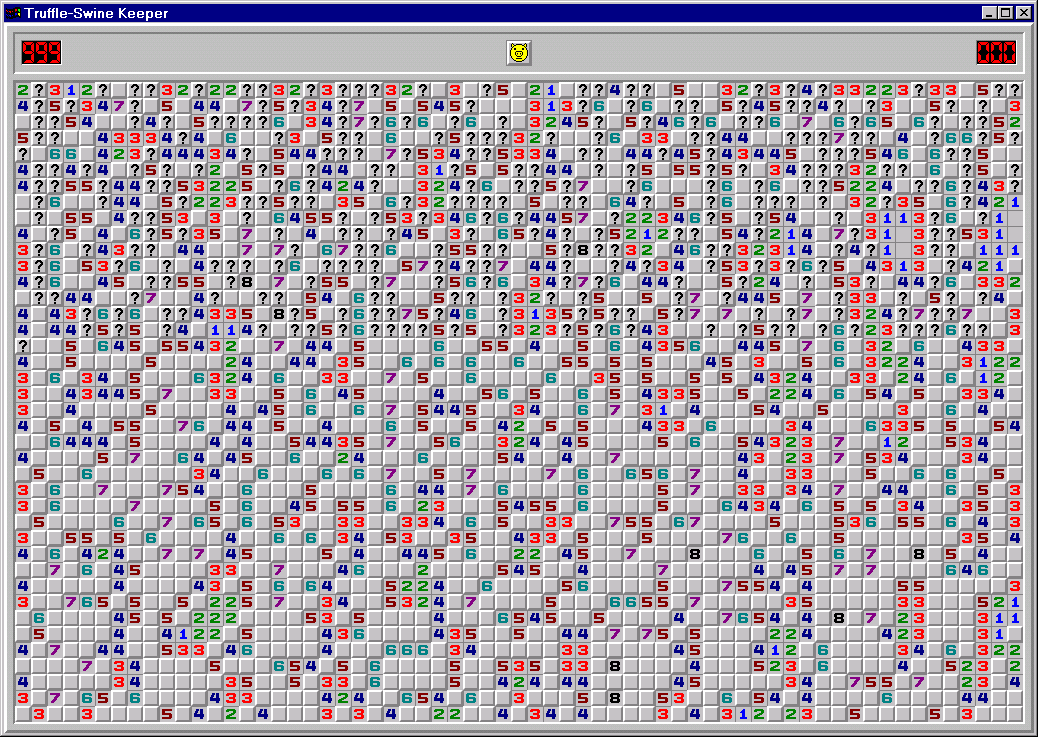
Of course, this sort of thing is what people did before computers were invented. Or televisions. Or fun. Nowadays, people can do all sorts of low-thought things to pass the time. Knitting and needlepoint. Crossword puzzles. TV. Reading mystery novels. Playing Minesweeper. And playing computer role-playing games.

The human brain just seems to have a need for resting, for passing some time in a low-energy state. Computer role-playing games are perfect for that. When I fight fifty basically identical combats against darkspawn in Dragon Age or spend five hours finally getting my level 13 druid in World of Warcraft to level 14 or piled a hundred bricks on top of other bricks in Minecraft, I’ve done more than waste my time. I’ve given by brain rest that, for reasons I can’t begin to understand, it craved.

And, of course, some of my friends think that I’m wasting my time, both designing the games and playing them. The same friends who don’t think twice about doing their five thousandth crossword puzzle, or reading basically the same damn mystery novel for the billionth time. Or read The Onion, like that’s such an enriching activity. People just like to fritter time away, and computers give us an unusually satisfying way to do it.

The most important thing about these low-brain activities is that they have to be rewarding in some way. They have to give us occasional positive feedback, little flashes of satisfaction. Sometimes, when whittling, you might carve away a particularly long and attractive spiral of wood. (Yeah. I know. Just bear with me on that one.) When knitting, you have the satisfaction of finishing your sweater. With a crossword puzzle, you feel smart when you finish.

And when playing a role-playing game, you get a constant, pleasing form of feedback in the form of gold and experience points. Or upgrading from a +1 to a +2 sword. Or getting a new spell, or completing a quest. Everquest is particularly cunning in the way it rewards the player. It has the character’s skills constantly creep upward, a tiny bit at a time, providing a constant stream of tiny rewards.

Now sure, when described this way, the whole activity sounds a little sad and lame. But really, when you think about it, if it’s such a pointless activity, why do we want to do it? I have found that, in general, our brains our smarter than we are. They want what they want, and if my brain wants to spend a while in front of a computer screen stabbing orcs, who am I to tell it it shouldn’t?

So there you go. In just the first column in this series, I’ve come up with a complete, comprehensive explanation for why it’s good and healthy and productive for us to like to play computer games. And I will recite it to myself, again and again, at two in the morning, when I’m lying awake trying to convince myself that I’m not wasting my life.