Showing posts with label omigodomigodomigod. Show all posts

Thursday, February 1, 2018

We Released Avernum 3: Ruined World.

Seasons come and go. Pages fall from the calendar. And Spiderweb Software releases another game.
In 1997, I wrote a hit game.

It was called Exile 3: Ruined World. It and its remasters are the most popular games I've ever written.

Bear in mind this game was a hit by 1997 shareware standards, not 2018 indie standards. It made enough to buy a modest 1997-priced house. It didn't make enough to buy a mega-mansion.  But I'm certainly not complaining.

In 2002, I remastered the game into Avernum 3. It sold a lot of copies. Then, this week, twenty years after its first release, we shipped Avernum 3: Ruined World, the second remaster of this title. If my email is to be believed, a lot of people want it.

This is a brief story of writing a game that did really well and figuring out how to deal with it.

Exile 3: Ruined World. 1997 shareware at its semi-finest.
The Science of Careful Theft

When I started Exile 3, I'd already put out Exile and Exile 2, and they'd sold well enough for me to go full-time. It was a modest living, but entirely adequate for a 26 year old in Seattle. (You didn't have to be an Amazon employee with a mega-salary to live in Seattle then.)

At that point, I'd been writing shareware for two years, was starting to feel a tiny bit confident and comfortable. I decided that I was really going to stretch my wings. I wanted my third game to be GOOD.

So I did what I usually do when I want to design something good.

I played every game that was popular at the time, stole the very best idea from each, and synthesized them all into one coherent title.

Here's the thing about stealing ideas: Everyone does it. We all stand on the shoulders of giants. It's knowing which tools to not steal, which ones to steal, and how to assemble them together to makes a real craftsman.

Computer Gaming World called Exile 3 the best shareware game of the year. They even gave me a prize. The logo is 2 chubby guys with bad posture sensually hugging a floppy disk.
The Game Was Big

From the Elder Scrolls games, I was inspired to write a huge game with tons and tons of towns. This resulted in Exile 3 being the biggest game we've ever written, by far.

I've written it three times now, and each time I have despaired that I would ever finish it. It's sickeningly huge.

Since I had so much space to fill and I was still young and crazy enough to feel free to do things that were genuinely dumb, this game has a lot of weird, silly stuff in it. Towns named after old sitcom characters. A giant dungeon themed after old karate movies. A whole chapter where the enemies are giant cockroaches. (Actually, I still think this idea is terrific.)

There's a reasonable amount of it that I'm sure I wouldn't do if I wrote it now. I was a lot looser and sillier when I was young. However, when I do a remaster, I need to trust my younger self. I left almost everything alone.

Avernum 3. A big upgrade from Exile 3, but it doesn't work so good on 2018 computers.
Then Again, Maybe I Had Original Ideas

I suppose when I say that all of my ideas are stolen I'm partly joking. There is a lot of cool stuff in Avernum 3 that was quite innovative when it came out, and I can't remember any games doing those things back then.

You can be a merchant or buy a house. There was already games that had this.

The world crumbles as time goes on. If you don't fight the bad guys, towns will fall apart and characters will die. If you're slow enough, a gigantic disaster happens and you have to deal with it or the world ends. NOTE: No matter how slow you are, you can always win the game, but not without consequences.

I wanted to make sure you felt that the world was bigger than your perception and that there were things going on you would never know about.

This is really cool, and I don't remember any other games doing this.

Avernum 3: Ruined World in all its low-budget glory. It was made cheaply, but it's fun.
Working As a Curator

When you do a remaster, you are the curator of your own work. You have a responsibility to your fans to keep everything they love most about the title intact. If you don't, they will punish you lavishly.

People tend to dislike change. If you change one thing, even if it's an entirely reasonable or even unquestionable change, you will always get complaints. These complaints can get very angry.

This makes remasters really grinding, painstaking work. I tried to put in lots of new ideas and designs and stuff. I improved the interface greatly. However, as much as possible, I left the world and story and feel of the game alone.

(There is one change I regret: The artist who made the character art doesn't work for us anymore, so I couldn't get horse art that would match the old style. Sorry about no horses.)

Thank You For Your Support

This wouldn't be complete without a thank you to the many people who have supported and stuck with us over the years. Your kindness has enabled me to live my childhood dream. I promise to work hard to be worthy of it.

Back To Creativity

After 16 months on Avernum 3, I'm really itching to do something new again. I hope I never have to remaster it again. Check in with me in 2033.

We are starting a whole new series. New world, new game engine, new system, maybe even a Kickstarter.

I hope you like Avernum 3. If you aren't sure about it, we have a demo. If you loved it as a kid, I hope that I kept the things you love alive.

On to the next.

Wednesday, October 11, 2017

Avernum 3, Remasters, and the Joy of Owning Your Work.

It's weird to see over four years of my life just sitting there in a lump.
I've been making my little indie games for a living for 23 years. Being a greybeard in such a weird and young industry comes with special privileges.

For example, while some of my peers are getting around to remastering their old games, I am remastering our most popular game, Avernum 3: Ruined World, for the SECOND time. It is only when you rewrite the same material twice that you really test your discipline and integrity.

Writing indie games has become miserably competitive lately. Most new games, even promising ones with a lot of work in them, are sinking without a trace. Yet, thanks to the grinding tedium of rewriting the same game again and again, I have a fighting chance of my business surviving enough to write cool new stuff.

So I'll tell the story or Exile 3: Ruined World/Avernum 3/Avernum 3: Ruined World. (Also on Steam.) There are things to learn here for any young person who thinks, "I wanna' make cool things (not just video games), and make a living doing it."

Don't laugh. It sold like crazy.
In A Previous Millenium, I Wrote A Hit

In 1997, I'd been making games full-time for a couple years. I wrote (and still write) retro, turn-based, low-budget indie RPGs with fun systems, interesting stories, and mediocre graphics.

Happily, I got started at a time when there were very few good RPGs out in the market. I got a nice computer, wanted to play a good RPG, and couldn't find one. So I wrote one. It sold, because no competition. This is a key example of my most important business strategy: Get Very Lucky.

My first games, Exile: Escape From the Pit and Exile 2: Crystal Souls, were designed on a simple principle: I would go back to all the RPGs I loved as a kid and steal the best idea from each one. I then carefully combined all my quality stolen ideas into a coherent whole. This is called being a game designer.

For our third game, I had a better idea. I spent months playing all the new RPGs that had come out over the previous 2-3 years. Then I stole the best idea from each one of those. Thus, I transitioned from stealing ideas from old games to stealing ideas from new games. This is how you evolve as a game designer.

I ended up with Exile 3: Ruined World, which has been our biggest success. It features a gigantic world, that is easy to get lost in. As time passed, the game world evolved. If you didn't fight the monsters off, they would ruin towns and kill the townsfolk. (Though, no matter how slow you play, you can always still win the game.) If you didn't want to follow the story, you could be a bounty hunter or merchant. You could buy a house.

(If you want to try it out, it's available as freeware here. Warning: It probably won't run on your computer. That's one of the reasons we had to remaster it.)

Exile 3 came out so long ago that most new computers then looked exactly like this.
It Was The Right Title At The Right Time

In 1997, it was what people wanted. It was a legit shareware hit. Now, having a hit indie game in 1997 (when the world wide web was basically nothing and most of my sales came from AOL) was different from having one in 2017.

These days, the sales of a hit indie game will buy you a mansion made of yachts. Back then, it bought me a modest house and made my parents slightly less ashamed to say what I did for a living.

I won awards, to the extent there were game awards back then. I got attention from the traditional games media, which was really worth something then. And it established me in the business for good.

But even then, I knew that the real prize was not the praise (which I don't care about) or the money (which is nice, but then you spend it and it's gone). What was really valuable was that I owned the game. It was mine. I could do with it whatever I wanted. Forever.

BEHOLD MY MIGHTY 800x600 PIXELS!
Five Years Later, I Rewrote It For the First Time

We rewrote Exile 3 as Avernum 3 in 2002. Five years is a really short time to wait before rewriting a game, but I have a good excuse. When I started Exile 3, I'd only been making games for money for two years, and I wasn't very good. There were a ton of ways in which the story, interface and graphics should have been improved, and I didn't know to do it.

I spent well over a year writing Exile 3, and my wife and I spent another year turning it into Avernum 3. We went over every single location, line of dialogue, and bit of code, improving and expanding it to the best of our improved abilities. The revised version didn't sell as well as the original, but it still made a lot of money. (Again, by early indie game standards. It was a lot of money for lone artists, but not big-shot money.)

(If you want to try it out, you can buy it super-cheap here. Warning: It probably won't run well on your computer. That's one of the reasons we had to remaster it.)


The new game. I am constantly accused by cranks of never improving my games. Look. I'm not saying this is super-fancy. But I don't think you can say there's been no improvement.
Now, Fifteen Years Later, We're Doing It Again

Fifteen years is a long time in the tech industry. Our most popular game is now woefully out of date in every way, largely forgotten, and doesn't even run on new Macs anymore. Now I can rewrite it so it actually works, and an iPad port will fall out of the process in the bargain.

Interfaces and game design have evolved in a million ways. I'm spending 18 months going over every tiny bit of the game again, redoing every single thing from scratch. I'll release it in January or so, and it will hopefully sell. I think it will. I've spent over 20 years building up a loyal fan base.

The Pros and Cons of a Remaster

The good side of remasters is that they can be less work that writing a game from scratch. You can, with luck, get a full new title for 2/3 of the work, and it's easy to market it because people already like it. (I'm assuming you're not remastering a game everyone hated.)

The bad side of remasters is that you become the curator for your own work. It can be grinding to go over old material day in and day out. The reason a remaster is successful is because your fans like the original game. You don't want to crap it up with too many new ideas, no matter how clever. People tend to not like change.

A Lesson For Young Creators

Never underestimate the value of owning your work. There hasn't been a day since 1997 that I haven't made money off of Exile 3. The reason is that I own it. It's mine, to alter, remaster, and distribute. All according to my whims, with all the earnings going to me.

It's a tough market out there. But suppose you release a new game and nobody ever even hears of it. Wait five years, remaster it and it really will be, as far an anyone is concerned, a new game. You can try selling it again!

And ten years from now, people will be using new consoles, new devices, new sorts of computers. Port your game to them! Each new port is an all new release. A new chance for your game to get noticed and catch on and become a hit!

Nature provides us with a perfect metaphor for any internet discussion.
"But Your Games Are All The Same And Look Like Crap"

I have a follow-up post about the reactions when I announced Avernum 3: Ruined World. It's pretty funny, but this is already long so I broke it out into its own post.

When Avernum 3: Ruined World comes out (hopefully in January for Windows/Mac and March for iPad), I'll have spent over four years of my life on it. It's not a game for everyone. It's mostly the product of one person, and it'll show.

Even if you don't like my work, I hope you take some satisfaction in this: Vidya games are still a place where one weirdo can make weird things for other weirdos and make a living at it. As long as this is possible, there's hope. Maybe the next weird thing for weirdos will be YOUR perfect game, the Best Game Ever, and it never would have existed in a purely big-budget world.

### 

If you're intrigued by the retro-RPG goodness of Avernum 3, you can wishlist it on Steam. News about our work and random musings can be found on our Twitter.

Edit: Added the Pros and Cons section.

Wednesday, September 14, 2016

We Released Avadon 3! (Also, a Few Words About Free Time)

Avadon is done. That's 5 years of my life, tied up with a bow.
I don't always write controversial, widely-read blog posts that make people way, way, WAY angrier than they should be. I also make games.

At last, we have completed the Avadon Saga! Avadon 3: The Warborn is out for Macintosh and Windows! We are selling this fine, indie, retro, story-heavy RPG on Steam, GOG, Humble Store, and our own site.

Our next step is to port the game to the iPad, and hope that Apple doesn't accidentally step on us with its big, lumbering feet.

I wrote in some detail about who we are and what the Avadon series is like in May. I don't like to repeat myself. I prefer to troll the Internet by bantering about whether or not video games are Art or not. (Answer: Good Lord! Who cares?)

It is very exciting to finish a fantasy saga, the third big one I've completed. I'm sure you find it perplexing, as taking forever to actually wrestle a story to the ground is a constant plague in the genre. My secret technique: 1. Sit down in a warm, dry place. 2. Figure out how the story ends. 3. Write that.

Anyway. What to blog about? I'm trying to make interesting blog post that people tweet about so I can get a tiny scrap of attention and maybe sell some games.

Avadon 3: The Warborn is my 16th full-length, all new game. (My 24th, if you count remasters. And I put a lot of time in my remasters.) This is a large number. I've been writing indie games an unprecedentedly long time, and aspiring developers, for some reason, are often interested in my advice about things.

So, since I'm entering my blissful quiet period between games, I wanted to say how I spend that time. Because I know some of my in-depth fans like to know how I make the stuff they like. And because, when you want to be a creator in the long term, profitably expending your downtime is vitally important.

(If you don't care about me or my process, and you shouldn't, your time may be more profitably expended getting a huge, free demo of a cool new RPG.)

So what am I about to do?

Screenshot of my game provided for crass self-interest purposes.
1. Rest.

"If you're going to rest, rest."
- Angry White Pyjamas 

If you are a driven, type-A person, it can be hard to rest. You might think, "Oh, I'll sit around for an hour, but first I'll write a blog post/make some calls/do some design work/not rest."

You need rest to live. Pick a time. Pick something that will rest you. Spent that time doing that thing. I know you're driven. That's why you are a success. You still need to refill your tank for when it really counts.

2. Play Games.

This is actually work.

While I write a game, I am filling my Steam library. If it's hip or gets my attention or is in a nice, cheap bundle, I buy it. Now is the time for me to try them. All of them.

The purpose of this is to evaluate the state of the art. Find out what sorts of designs are hot now. Sample all of the weird mash-ups indies have come up with. ("Procedurally generated tower-defense roguelike") Look for new interface innovations, and see what irritates me so I know not to do that.

I play each game until I think I've seen everything new it has to offer. Most games get 15 minutes, tops. I especially try games in my genre, RPGs, even though I hate the vast majority of them. (I am a VERY jaded RPG gamer.)

Every once in a while, I find that rarest of treasures: A game I actually enjoy playing. This is a true treat. I actually play it for a while for fun, to remind myself why I do this. (This time around, I'm playing a lot of Inside and Salt & Sanctuary. Great games.)

As always, terrific color art provided by Ben Resnick.
3. Gather Ideas.

When I am not formally working on a game, it's a wonderful time to just go for long walks and thing up ideas. Stare at a wall. Listen to music. Think. Imagine. Write down what comes to me. It's a wonderful bit of freedom, to just let my brain wander.

99 out of 100 ideas are never used. But that 100th idea? That might be the bit of gasoline that fuels years of productive development.

But Back To Avadon. There Is a Demo.

Demos of games are vanishingly rare now, but I'm cranky and stuck in my ways, so I provide them. I don't want to take your money until you are sure the game functions and you like it.

We still have the biggest demos in the biz. You can download one on Avadon 3's page on our site.

(By the way, since I am often asked, we get the biggest cut of $$$ when you order using the Humble widget on the game's page. This comes with a Steam key. However, I am very grateful when you order no matter where you do it from.)

I'm still really happy with this screenshot. Looks even better in the trailer.
I Hope You Like the Game

The Avadon trilogy was very different from what came before. A lot of new people loved it. A lot of our old fans really didn't. I genuinely enjoy playing them, so I'll vouch for them. I think Avadon 3 is really cool. It's a gruesomely tough market, but I'm optimistic. I hope you like it.

On to the next thing ...

Wednesday, May 4, 2016

Avadon 3, Announcing New Games, and Facing Your Inadequacy.

Aaaaaand ... we're off!
We have just announced our newest game, Avadon 3: The Warborn!

It's the final game in the series! At last, you get to end the war, pick a winner, and decide who lives and who dies! (Though we are making sure that the game will still make sense and be satisfying even if you didn't play Avadon 1 and 2.)

It should be out in September, unless things go wrong. Completing this series will bring an end to five frenzied years of my professional life.

I wanted to talk about the game a little, for people who don't know about us, people who do, and people who are interesting in making games in general.

I'll try not to be boring.

If You Don't Know Who the Hell We Are ...

Hi! We're Spiderweb Software. Since 1994, we have created indie, retro, turn-based, huge, epic fantasy role-playing games. We specialize in games with intricate stories that give you a lot of interesting choices. We also like making fun game systems and varied combat with lots of unusual encounters and tactical options.

If that sounds cool, just stop reading this. Go here or here and download a big, free demo. We have always had the biggest demos in the business. If you like what you try, all of our stuff is on Steam.

If You Already Play Our Games ...

Thank you for your support!

We asked for a lot of fan feedback before we started Avadon 3, and we put a lot of it into effect. There are a ton of changes and improvements in this new game. Many long-overdue interface improvements. A lot of rebalancing and new abilities. Fewer trash fights and greater encounter variety.

I managed to generate some pretty decent screenshots this time around.
What Is Avadon About?

If you want the basic facts of the story, they are on the main game page, and I'm tired of rewriting it. (This is the sort of disciplined approach to PR that has enable me to maintain decades of consistent anonymity.)

I'm more interested in talking about the process.

In the 20+ years I've been doing this, I've always had one main habit: I write the sort of game I enjoy playing. They are always RPGs, because I am obsessed with that genre. It's a genre that allows for great variety. (And the basic, addictive elements of which have infected just about every other genre.)

Whenever I'm not sure what to do with a game, I always make the choice I would prefer if I was a player. It's a compass that has almost never steered me wrong.

When I decided to write Avadon, I'd just played Dragon Age: Origins, which is still, for my money, one of the finest RRPGs every made. It made me want to write a similar game: An epic story, full of intrigue, dark fantasy, and touch choices, set in a huge and complex world. I wanted the battles to have their own flavor, with lots of different tactical options and unexpected events, and in which movement and positioning are really important.

I think I succeeded. Kind of. I will say that I enjoy playing Avadon games more than I enjoy playing any of my other games. A lot of my fans don't care for Avadon as much, but that's ok. We write a lot of different sorts of RPGs.

Actual gameplay footage!
But I'm Ready To Move On and Feel Bad About What Has Come Before

Like many creators, I hate looking at the work I've done. Even if it's good, it still pales in comparison to the beautiful image I had in my mind when I began. Looking at the final work can be a painful process.

A painful process, but a helpful one. When you fail to do what you wanted to do, well, failure can be very educational. You just need to look hard and honest at you failures and see what you can do to correct them.

So, some things I'm unhappy with about the Avadon series.

When I was designing Avadon, I was very ambitious. Lynaeus, the continent on which the series takes place, has 5 friendly nations and six hostile nations, each of which has its own politics, history, and so on. I wanted to make a whole world.

In the end, however, I was just one designer.

There are so many factions, wings of government, conflicts, controversies ... Too much for me to keep track of, too much to fully develop. I wrote so much lore I could never find a place to fit into the game. There were so many locations I just wasn't able to give enough time to.

My eyes were bigger than my stomach on this one.

Also, i didn't put as much polish in these games as I should. Avadon 3 will have a lot of careful rebalancing and useful interface improvements. However, these changes should have been in Avadon 2. Honestly, a lot of these things should have been in Avadon 1 so I didn't have to fix them in the first place.

I have a good excuse for some of this. I'm only one person, and I'm getting older and slower. Still, a problem is a problem, and, if I'm asking people for money, I'm still responsible for flaws.

Finally, I've stuck with this particular engine, graphics style, and world style for too long. After I remaster Avernum 3 (our most popular game over the years), I'm going to do something way different. It's well past time.

Actual gameplay footage!
I Also Have Reached My Own Limits

However, the Avadon games have also reached the limits of what I am capable of holding in my single brain. They are the limit for how complex I game I can make without going mad. There's just too many characters, story threads, and so on. After a few months of keeping everything balanced and in my head and making sense, it gets exhausting.

One of the great pleasures in my job is finishing a game and being able to forget everything I've had to hold in my mind, ready for fast access. It's like putting down a heavy weight. I'm really looking forward to letting Avadon drift away. It's been like having to have a second family, only in my head. A weird, dysfunctional, non-existant family. I want it to fade away and leave a blank canvas, that I can fill with other fun stuff.

And, in Avadon's sprawling messiness, I think we made something really neat. Among all of the treasure hunting and epic battles, this is a story about running a fading Empire. You have borders to protect and unlimited power to do so. Will you be cruel or merciful? Will you be dutiful to your country, or will you focus on power for yourself?

Avadon 3 is full of choices, and your decisions will lead to a multitude of possible outcomes. No cop-out twist endings. It won't all have been a dream. We will make sure that the series caps off with a satisfying ending.

We'll be starting an all-new series soon. When we do, it will still be a big, complex game, but it will be big and complex in a different way. At the very least, there will be fewer than 11 countries for you to keep track of.

Back To Work

And that's all for now. Hope you like the screenshots and the trailer. If you're new here and like RPGs, we have 20 years of back catalog to tempt you.

Time to go write a few thousand more words of dialogue!

Wednesday, May 21, 2014

The Indie Bubble Is Popping.

Writing this article really stressed me out. I reworked it over a dozen times. To calm down a little, I will intersperse this with image that came up when I Googled "Free cute animal clip art." Here, we see a teddy bear who is addicted to The Spice.
I've been threatening to write about the popping of the Indie bubble for some time. Everything has finally started to come together. It's a miserable thing to have to talk about, but the conversation is long overdue.

First, a brief history of the Indie bubble. In 2008, big budget developers were doing fine, but they had mostly abandoned a lot of genres many gamers loved (puzzle games, adventure games, 2-D platformers, classic-style RPGs, Roguelikes, etc.)

A few young, hungry developers stepped in and showed that classics can be written on low budgets by young, plucky people with unruly facial hair. (Braid. World of Goo. Castle Crashers. Minecraft. And so on.) They were rewarded with huge accolades and many millions of dollars.

Shortly after, other developers stepped in with their own games. They weren't quite as classic, but they were decent, and these people made fewer millions of dollars. Some old super-niche developers (Hello!) were able to rerelease old games and get caught in the rising tide.

Then even more developers, sincere and hard-working, looked at this frenzy and said, "I'm sick of working for [insert huge corporation name here]. I would prefer to do what I want and also get rich." And they quit their jobs and joined the gold rush. Many of them. Many, many. Too many.

And now we are where we are today.

Indie gaming has seen things you people wouldn't believe. Attack ships on fire off the shoulder of Orion. C-beams glitter in the dark near the Tannhauser gate. A deer rocketing through a forest powered by its own poop. All those moments will be lost in time, like tears in rain. Time to die.

Is it me, or is this bunny totally murdering this other bunny? IT'S GETTING REAL!
My Thesis. (I Have One.)

Anyone who knows anything about me knows that I am in love with games. Video games in particular. Indie video games in super-particular. I am more smitten with them than I should be.

(That’s why I’m not angry at the big mobile game makers. They found a way to get my parents to want to be gamers! That’s awesome. I could never do that, and I lived with them!)

The rise of indie gaming over the last few years has been fantastic. It’s given birth to a lot of good, well-funded companies, that have the chance to make great products. (Like Transistor, that, as I write this, just came out.) As long as these companies keep making top-quality work on a reasonable schedule, they’ll be fine.

But lots and lots of other companies are trying to enter the space, and I’m not sure how many of them are aware that things are changing rapidly. Strategies that were sold to them as the Way To Go are rapidly becoming less effective, while forgotten strategies from back in the day may deserve new consideration.

(Of course, I'm talking about PC indie gaming here. On mobile, big free-to-play stomped out the little guys years ago.)

So what this grumpy old fart is saying is that there are Issues. They should be discussed. There are new obstacles that should be planned for and forces you may blame for your problems that, in fact, you shouldn’t. If you are a green developer, face these facts, or I believe destruction awaits.

The easy money is off the street. If you want to make it in this business now, you have to earn it. It's a total bummer. Blaming Steam won't help.

Enough preamble. Let's get to the evidence, shall we?

This adorable dinosaur is mocking your dreams.
The Big, Big Problem. The Only Problem.

The problem is too many games.

How bad has the problem gotten? How towering, bleak, and painfully unavoidable? It's gotten so bad that even the gaming press has noticed it.

Steam released more games in the first 20 weeks of 2014 than in all of 2013.  I don't know why anyone acts surprised. How many times last year did we see the article, "Another 100 Greenlight games OK'ed for publishing!"?

This wouldn't be a problem if there were a demand, but there's not. After all, almost 40% of games bought on Steam don't get tried. As in, never even launched once! At least the people who download free-to-play games try them.

(To be clear, this isn't a problem because these games will keep people from buying new ones, though there will be some of this. People mostly don't play these excess games because they didn't want them. The problem is that a business based on selling things people don't want is not a stable one.)

Because this flood of games is so unmanageable, Steam has been doing everything it can to throw open the gates and get out of the messy, stressful business of curation.  This is absolutely inevitable. It's also going to winnow out a lot of small developers, who don't have the PR juice to get noticed in the crowd. (Think iTunes app store.)

With so much product, supply and demand kicks in. Indies now do a huge chunk (if not most) of their business through sales and bundles, elbowing each other out of the way for the chance to sell their game for a dollar or less. Making quick money by strip-mining their products, glutting game collections and making it more difficult for the developers who come after to make a sale. (I am NOT making a moral judgment here. It is the simple consequence of a long series of calm, rational business decisions.)

Indie gaming started out as games written with passion for people who embraced and loved them. Now too much of it is about churning out giant mounds of decent but undifferentiated product to be bought for pennies by people who don't give a crap either way.

It's not sustainable.

When I asked this lion, "Will Steam Early Access make things better?", it made this face. And then it mauled me.
It Really Is the Only Problem.

It's simple math.

All gamers together have a huge pool of X dollars a year to spend on their hobby. It gets distributed among Y developers. X stays roughly constant (up a little, down a little), but Y is shooting up. A fixed pool of money, distributed among more and more hungry mouths.

Those mouths are your competitors. All your heroes? Notch, The Behemoth, J. Blow, etc? They’re your foes now. Are you ready to fight them?

You can talk all you want about how mean Steam was to you, or how much "discoverability" is a problem, or about how important it is for developers to go to GDC or the PAX Indie Warren or to cool game jams or whatever. It's all a distraction.

X dollars, Y developers. That's all that matters.

And if X stays constant, the only way to solve the problem is for Y to go down. I'll give you a second to work out the consequences of that for yourself.

Another Dimension To The Problem

I can already sense people are unconvinced with my "proof" of why a shakeout is ahead, so I need to point out something else. It's the problem with being a middle-sized developer (a problem that extends to many fields, not just games).

Suppose you are a super low-budget micro-developer like me. It's not super-hard to survive, because I can get enough sales to get by with a little cheap marketing and word of mouth advertising. I'll be all right.

Suppose, alternately, you are a huge AAA developer with massive budgets. You can afford the massive marketing necessary to generate the big sales you need to pay for your expensive games. You'll be all right, until you're not.

But suppose you're a mid-tier (sometimes called AAA Indie) developer, with $500K-$2 million budgets. You have a problem. You need advertising to get sales, as word-of-mouth won't cover it. But you can't afford a big campaign. The only way you will turn a profit is if you get huge free marketing from Steam/iTunes placement and press articles. (Which is why going to big trade shows and cozying up to the press is so important.)

But when there are so many games competing for free marketing, you have a serious problem. According to their site, the Indie Megabooth at the last PAX had 104 games. 104! At one PAX! Just indies! The games industry doesn't need that many games this year, period. #mildexaggeration

If you are an established developer journalists love, like Supergiant with Transistor, you have a chance to stand out from this horde. If you don't already have a hit, I don't know what to tell you. If I were you, I strongly suggest you write an utterly flawless, ground-breaking title and utterly blow everyone’s minds.

It's a rough spot to be in, and that's where a huge chunk of current indie development has placed itself. Some will shrink down, some will leap to the higher tier. But it's going to be super rough in the middle. Again, to see how this works in real life, look at iTunes.

Oh, and by the way? If you disagree with me on any of this? I HOPE I'm wrong! I want you to convince me I'm wrong!

Anyway.

Um, I said "cute" animals. Come on, Google. YOU HAD ONE JOB!
Stop Blaming Steam!

I am somewhat irked by developers blaming Steam for their problems. "Why don't they publish me? Why don't they feature me? Why won't Steam make me rich!?" All of it said in exactly the tone of voice my 8 year old uses when she's angry her older sister got a bigger piece of cake.

If there has been one true hero in this story, it has been Steam. If, in 2008, I'd written my dream list of what a publisher could provide to help the little developer, Steam would have done it all, and then some.

I have a private theory, that's really only in my own brain. It's this. Valve is full of really cool people, who truly love games. But, at some point, with Steam, these basically nice people suddenly found themselves in the position of deciding who lives and who dies. It's a stressful, miserable place, and they didn't like it. It just made it harder to get out of bed in the morning.

In the last few years, Steam workers were the ones who handed out the golden tickets. They gave one to me. (Everyone on Steam made a lot of money. Even niche-developer dingleberries like me. You could put Pong on the front page at $20 a copy and still make a fortune.) The guy next to me who didn't get the ticket? He was angry. At Steam, at me, at the world. But mostly Steam.

Steam found themselves in a position of being hated for something it could do nothing about. Not to mention the fact that the sort of curation they were doing was impossible in the long term. You shouldn't want the games you can buy to be controlled by some guy at a stand-up desk in Bellevue, WA. They aren't wizards. They can't tell what's going to be a hit any more than anyone else. The free market has to do that job.

So they stood aside and opened the floodgates. Supply shot up and demand stayed even, which means, by a certain law of economics (the first one, in fact), prices have to drop. Which brings us to the bundles.

Christ. How long does this blog post go on for anyway?
The Bundles. Oh, So Many Bundles.

I've long been a vocal fan of Humble Bundle. They're good people who want to make the game industry cooler. Their sales widgets are an amazing tool. We use them ourselves. Their bundles started out as a fantastic way to showcase what our slice of the industry has to offer and help charity to boot.

Now, however, there are a lot of bundles. Many of them. Their main purpose: help established developers squeeze a few more dimes out of fading (or faded products). They are a product of the glut.

As I write this, Humble Bundle is running two weeks of DAILY bundles. That's, like, 3-10 full-length games a DAY. Spend a hundred bucks or so, and you'll get enough solid titles to keep you occupied for years. You should do it. It's a bargain. Then you'll only need to pay full price for the one game a year you really care about, and you won't need to worry about risking cash experimenting with new developers.

Then, give it 2-3 years, and you won't have to worry about new developers, because there won't be any.

Again, there is NO moral judgment here. We're all making calm, rational business decisions. I'm just saying where it's going. Where it has to go.

It just can't last. Bundles used to earn a ton, but they don't anymore. If making pennies a copy selling your games in 12 packs is the main source of a developer's income, that developer is going to disappear. Also, all of the bundles and sales encourage users to expect to pay a price too low to keep us in business. It’s just the same race to the bottom as in the iTunes store, except this time we were warned, and we did it anyway.

And hey, I’m not blameless in this. My games have been in a million sales and bundles. It’s what you have to do now, and I’m just as fault as everyone else.

If someone tells you this is the slightest bit sustainable, they are misleading you. There are lots of different reasons to do this. Maybe they need to fool you. Maybe they need to fool themselves. Just don't believe them. X dollars, Y developers. That's all that matters.

"FTL, what is best in life?" "To crush your enemies, see them driven before you, and to get sweet iTunes store placement."
Just One More Data Point

Actually, what drove me to write this, more than anything, was the first minute of last week's Zero Punctuation. It's kind of a gut punch.

It's the time of year when Yahtzee normally shines his giant flashlight on some under-noticed, deserving indie game and elevates it to the big leagues. Instead, he threw up his hands and reviewed the 2012 title FTL. FTL!

Seriously, what sort of review can you write about FTL in 2014? I can cover it in four words: "Yep. It's still FTL." What? There's an iPad version out? Fine. Ten words: "It's still FTL. Also, the iPad version doesn't crap itself."

(To be clear, FTL is a very good game. But I suspect that, at this point, its authors wouldn't mind sharing a smidge of the spotlight with a less established developer.)

With so many games out, picking the good ones out of the crowd is a huge job. As far as I can tell, nobody, and I mean nobody, is willing to do it. This is why, despite such a flood of product, so few games have broken out from the crowd so far this year.

If most of the indie developers went out of business, are we so sure that, outside of the game dev community, people would even notice? Are we so sure a hearty herd thinning isn't what they secretly want?

I Shouldn't Have Written This.

Because it's redundant. I mean, we knew all of this, right? Gamers certainly know. It's been a few years since looking at the new indie games went from, "Ooh! Let's see what treats await me today!" to "Aaaahhh! So much stuff! I am stressed out now!"

Also, it bums me out. I feel like some jerk who sees a guy's pants fall down and points and laughs and shouts, "HA HA! Your pants just fell down!" The pants-down guy has my sympathy. My sales are way down too, so if you hate me, I hope that fact gives you a little smile.

But all this stuff seems pretty obvious. Someday, as things shake out more, I want to try to get into a much more interesting, chewy topic: What happens next? And, if you still want to write indie games, perhaps a grizzled old survivor of multiple booms and busts can provide some helpful ideas.

---

Edit: I fixed a date and corrected the number of games in the Humble Daily Bundles. I swear I fixed that once, but the correction was lost in the flurry of rewrites. Also, anyone who wants to hear more of my natterings can follow me on teh Twitter.

Wednesday, July 27, 2011

Announced ... Avernum: Escape From the Pit


This blog has been sadly neglected lately, due to a combination of vacations and a frenzied effort to get our newest game to a point where we could officially announce it. But that day has arrived. Drop by our web site and take a look at Avernum: Escape From the Pit!

This is the second time that we have rewritten the Exile/Avernum trilogy, a move that is full of all sorts of questionable integrity. I am very nervous about announcing this title for exactly that reason, even though we have very, VERY good reasons to do a serious, polished rewrite of this game. Because Avernum has such a large and passionate fanbase, we have already put up an Avernum: Escape From the Pit FAQ to answer many of the questions that will be coming up. Such as, Why?

Short answer: Because the old version doesn't run on new machines anymore. Also, the iPad.

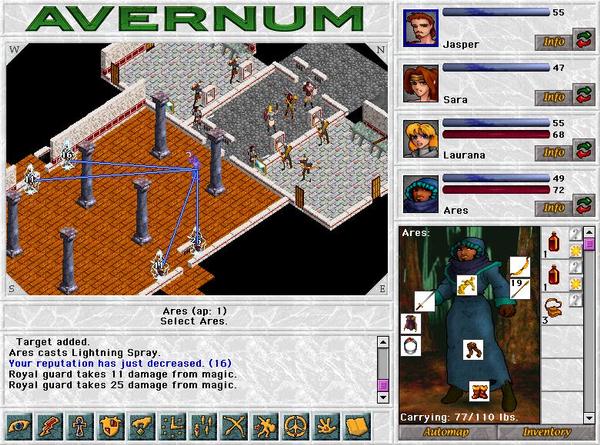
Longer answer. Look at this screenshot from Avernum:


Ghhhhahhhhh! Make it go away! Make it go AWAYYYYYYYY!

I mean, seriously.

We've been very determined not to half-ass this adaptation, and, when all is said and done, we will have put almost as much time into it as into a whole new game. It's been a little rough, and yet, I don't see how I had a choice. The first Avernum trilogy is my first creation and still one of my most beloved, and if we didn't rewrite it then it would have just disappeared. I can't abide that.

Other terrifying decisions. For the first time ever, we will be selling a new title for $20. When we released our first game, wayyyy back in 1995, we charged $25. At the time, that was a fair and unsurprising price for a shareware game. These days, the constant downward pressure on prices can no longer be ignored. Also, the market is developing in ways that finally make me think that we can make more money at lower prices.

I now hope to return to a sensible and semi-regular blogging schedule. For example, soon I will write a sort of review of LA Noire. Before I can write it, I want to see if the game ever has a murder victim that isn't naked.

Thursday, June 23, 2011

Our First Game Is Out For the iPad. Hooray!


Last week, Avadon: The Black Fortress HD for the iPad went live in the iTunes App Store. The reaction to it so far has left us stunned. Literally. Like, jaws dropped, walking around in a daze.

The genesis of the iPad version was a few months ago, when I said, "Hmmm. I have a few weeks free on my schedule. I think I'll port Avadon to the iPad. That'll be good for a laugh!" I've long known that there was a demand on the device for old school gaming, free of ads, in-game purchases, cute animals, zombies, and farming.

But, it turns out, the demand was far greater than I'd ever guessed. My fan mail since the release has been very instructive. Gamers weren't just disappointed by the lack of deeper games on the device. They were downright irked.

But that is the Magic Power of the Indie developer. Find an underserved market and serve it.

Writing and releasing my first device for iOS has been very instructive. In case anyone is interested, here's a few comments on Spiderweb Software's first game for portables.

Learning To Code For a New Platform.

Apple has done an amazing job of making developing for iPhones and iPads accessible. The sets of commands to program the device (i.e. the API, called Cocoa) are very clear and not too trying to learn. The development environment, XCode, is free. There are several good, free game engines for the devices. (I used a heavily modified version of the open source engine iPTK.)

There are also excellent books available on the topic. I leaned most heavily on Beginning iPhone 4 Development. I found iPad Application Development For Dummies to be unusually poor for a Dummies book, but its chapter on Provisioning (a tricky, vital, and neglected topic) is easily worth the cost of the book.

A Decent Port. But Just Decent.

Avadon originally came out for Windows and Mac. I was really determined not to half-ass the port to the iPad. I put a lot of thought into how to best adapt an old school, Western-style RPG to a touch screen. It's not something people have spent a lot of time doing. I think I came up with good answers to a lot of the questions, and the game overall plays really well.

However, there are a number of places where the UI could be better. This isn't because I was lazy or wanted to dump shoddy work on the market, but simply because this was my first iOS application. So have mercy. Our next game for the iPad (out, let's say, next April) will be better. It'll take some doing to modify the engine, but it'll get done.

Avadon HD is also a fairly demanding app. All of those icons eat up RAM, and the first generation iPad doesn't have a lot. It's playable, but it will be pokey from time to time. It runs great on the iPad 2, but I don't take a lot of satisfaction in that. The inconsistent performance on the iPad 1 is, simply, a failing on my part.

The Apple Approval Process.

Took a week to get my app approved. No rejections. No hassles. No complaints.

The Eternal Pain of Pricing.

It hasn't all been love and group hugs. Some of my fans have been seriously furious that we sell Avadon for Mac and Windows for $25 and the iPad version is $10. Like, "I will never be your customer again. Die in a fire." furious. I don't normally explain my decisions about pricing, but this merits a few words.

The same game is almost always priced differently on different devices. If you look at the prices charged for, say, Peggle, Plants vs. Zombies, or Angry Birds on different platforms, you'll find a huge variety. Angry Birds on the iPhone? One dollar. On the Macintosh? Five dollars. That's a five times difference!

There are a variety of reasons, all of them out of my control, for why I feel it is appropriate to charge less for the iPad version:

1. It has fewer features, due to the limitations of the device. Most notably, it is stuck at 1024x768 resolution and there are no keyboard shortcuts.
2. Since it is being sold by Apple, it is subject to the rules of their system. Most notably, there is DRM, and we can't give refunds through iTunes. Games bought directly from Spiderweb have no DRM and a Money Back Guarantee.
3. When you buy Mac/PC Avadon from us, you get a registration key that can be used to unlock an unlimited number of copies, over both Mac and Windows. A registration over iTunes isn't quite so liberal.
4. There is no ability to mod the game. This matters to more people than you might think.

But the main reason Avadon HD is $10 is, to be honest, that is the only possible price. Any more expensive, and it will cost way too much for an app. Any cheaper, and we're charging too little for what is still an old school niche product with a limited audience. If you try to look at it from our perspective, I think you will see that we didn't have a lot of options here.

One More Disappointment.

We are going to release all of our new games on the iPad. No question.

However, we currently have no plans to write games for the iPhone. After long thought, I came to realize that we just can't figure out how to write the sort of in-depth games we like to do on that screen size. Again, this is a failing on our part. I'm sure some intrepid developer will find a way to make it work. (Hear that, young Indies? That is the siren song of a market for you, all wrapped up with a big, red bow.)

Also, since most Android devices don't have a screen big enough to support our games, we are very unsure how soon we'll be supporting that platform. We are in wait-and-see mode.

Thank You.

And finally, many thanks to everyone who reads this who has supported our games. At the end of the day, I'm just a guy in a basement trying to earn a living and feed the kids. I am grateful for every sale. Plus, they make it possible for me to write more games. Lord knows, by this point, I'm too old and cranky to learn how to do real work.

Soon, we will release the first screenshots and information for Avernum: Escape From the Pit. For Windows and Macintosh. And the iPad!

Wednesday, March 2, 2011

Avadon: The Black Fortress Released.


On Monday, after fifteen months of work, Spiderweb Software released Avadon: The Black Fortress.

I'm writing this on Wednesday, after a week spent in a pretty continuous state of total freaking out. I am always nervous when releasing a new game. But a new game in a new world with a new system? After spending an unusual amount of time on it? I've been going kind of insane.

For those who are interested, early sales are quite strong. I'm starting to suspect that we aren't about to go out of business. And yet, most of the early sales are to die-heard fans. The question is how many new people will play it and like it. I think that it's solid, the world is cool, and the game itself is a lot of fun to play. But I might be wrong. It happens all the time.

Releasing a new game also means that I have to read my forums, which, as I have written before, is painful. Even for a solid game, most of the things that are written will be critical. It's only with time that I can get a read on how good the good parts are.

This is also when I have to take the lumps for unpopular but necessary choices I had to make. The biggest complaint is that the game has no keyboard movement. Our other big series, Avernum, takes place on a fairly simple grid, so keyboard movement is easy to implement. Avadon takes place in a larger world with no simple grid for the characters to stand on, and keyboard movement just doesn't work as well as the mouse, especially for distances that aren't very short. But some people really want keyboard movement, and I can hardly tell them they are wrong. I just have to take the criticism and hope that the game is good enough.

I've also been criticized that the game text is too small, and I'm taking that to heart. I am going to work on using a larger font for dialogue and special encounters, which should help a lot.

But now I'm rambling. Releasing a game is only the beginning of a long process. Maintenance. PR. Sequels. I hope you try it out. I hope you like it. And I hope Spiderweb gets to stay in business.

On to the Windows port (hopefully out at the end of April). And the iPad port (I have no idea when this might be ready).